Copied deck chairs: Frankfurt court holds the foreign supplier liable too
Your contact person

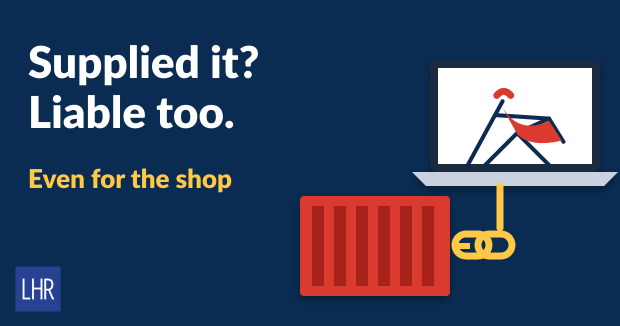 A retailer sells garden deck chairs online that look confusingly similar to the original, and loses in court. Ordered to disclose his source, he names his supplier: a manufacturer abroad that has the chairs produced under its own brand.
Is that the end of the matter, since the manufacturer itself never sold anything in Germany? The Regional Court of Frankfurt takes a different view.
In a judgment of 2 September 2026 (case no. 2-06 O 156/25), the Regional Court of Frankfurt am Main (Landgericht Frankfurt am Main) prohibited a foreign manufacturer from distributing near-identical imitations of garden deck chairs, and expressly did so with regard to the online offers of its German customer as well. The claimant manufactures adjustable, folding deck chairs and has been selling its product line for many years. It had already succeeded against the retailer who offered the copies online, in earlier proceedings before the Regional Court and the Higher Regional Court of Frankfurt (Oberlandesgericht Frankfurt am Main); the retailer was ordered, with final effect, to cease and desist and to provide information. As so often, that information led straight to the supplier.
Unfortunately, we were unable to retrieve the full text of the judgment from the Hesse state database. We therefore rely on the available reports and on the excerpts from the grounds reproduced on dejure.org.
Overview
- The design language of an entire product line is protected
- Why doesn’t the manufacturer’s own brand on the chair help?
- The supplier is jointly liable for the retailer’s offers
- What manufacturers and retailers should do now
- Frequently asked questions about liability for imitated products
- Further information
The design language of an entire product line is protected
The legal basis is supplementary protection against imitation under Section 4 no. 3 of the German Act against Unfair Competition (Gesetz gegen den unlauteren Wettbewerb, UWG). The claimant did not need a registered design or a patent. What mattered was the so-called competitive distinctiveness (wettbewerbliche Eigenart) of its chairs, that is, whether the public sees in their design an indication of a particular manufacturer. The court found that it did, not because of any single feature, but because of the interplay of several characteristic elements: a lambda-like double-U leg structure, a footrest hinged to the armrest tube, armrests resting against only one of the two tubes, indirect upholstery with visible longitudinal supports and a continuous gap, and a headrest.
None of this is technically necessary, since the market offers numerous other solutions for the same purpose. According to the judgment, protection extends not only to a single model but to the product line, because its recurring design language makes the individual chairs recognisable as belonging to it, even where colours and details vary. Accessories hardly matter: sun shades and drink holders are, in the court’s words, perceived “as a typical accessory product” and are to be given considerably less weight in the overall impression, if not disregarded altogether. Anyone who thinks a differently shaped cup holder creates enough distance is mistaken.
Incidentally, a market full of copies does not help the imitator either. According to the judgment, competitive distinctiveness is not lost as long as the public still distinguishes between the original and the imitations. Germany’s Federal Court of Justice (Bundesgerichtshof, BGH) had already stressed in its 2007 “Gartenliege” (garden lounger) decision (I ZR 104/04) that long market presence and high sales figures can strengthen the distinctiveness of a piece of furniture. The chamber expressly follows that line.
Why doesn’t the manufacturer’s own brand on the chair help?
The manufacturer had marked its chairs with its own trade sign. In the court’s view, that is not enough to rule out deception as to origin. Buyers understand such a sign as a retailer’s brand, or assume a second brand or a licensing relationship. The buyer only has to assume that the product comes from a particular manufacturer, whatever that manufacturer may be called, or from a company connected with it.
In online retail this is hardly surprising. In the typical frontal view on the product photo, the copies created an almost identical impression. Nobody sees a small logo on the side of the frame there, and even those who do will not conclude that an unrelated company is behind the chair. According to BGH case law, labelling only rules out deception as to origin if it is clearly visible and buyers actually rely on manufacturer information when purchasing. With garden furniture bought from a web shop, that is rarely the case.
The supplier is jointly liable for the retailer’s offers
For manufacturers abroad, the truly important part of the judgment is attribution. The manufacturer had not offered anything in Germany itself; it had merely supplied the retailer. According to the judgment, however, both defendants acted on a division-of-labour basis, so that the supplier shares responsibility for the retailer’s online offers. As far as can be seen, the chamber bases this on the principles of joint liability under Section 830 of the German Civil Code (BGB).
This closes a gap that many manufacturers consider comfortable. Anyone who has copies produced in the Far East or elsewhere outside the EU, supplies them under their own brand to a German retailer and does not concern themselves with the resale could previously hope that the rights holder would be content with pursuing the retailer. The Frankfurt judgment shows that, once the retailer has disclosed its source, the rights holder can go directly after the supplier, with claims for injunctive relief, information and damages under Section 9 UWG.
Being based abroad offers little protection. For EU trade marks, the BGH ruled only in October 2025 (judgment of 22 October 2025, I ZR 220/24) that what counts for online offers is the consumers targeted, not the seat of the provider or the location of the server. Anyone who deliberately supplies goods into the German market must therefore expect to face German courts. We do not know whether the Frankfurt judgment is final.
What manufacturers and retailers should do now
In our practice we regularly see imitation disputes start with the retailer and then move up the supply chain. The judgment confirms this route and makes it more predictable for rights holders. For manufacturers supplying Germany, and for their customers, this means:
- Before entering the market, check whether a product comes close to a well-known original in Germany or the EU. The absence of design or patent protection for the original does not mean that the copy is permitted.
- Create distance through the characteristic features, not through accessories, colour or a small logo. What matters is the overall impression, in online retail above all on the product photo.
- Add provisions on intellectual property rights, indemnification and recourse to supply contracts with German retailers. A retailer who loses in court must name its supplier, and it will.
- Respond quickly to a warning letter and assess the situation for the entire supply chain before anyone signs a cease-and-desist declaration or faces an application for a preliminary injunction.
- Rights holders should make consistent use of the information claim against the retailer to reach the manufacturer.
We have previously reported on a decision of the Regional Court of Cologne (in German) on a retailer’s recourse against its supplier. The Frankfurt judgment goes one step further: the rights holder does not need the detour via the retailer.
Frequently asked questions about liability for imitated products
Is a copy permitted if the original has no registered design?+
Is a manufacturer abroad liable for the offers of its German retailer?+
Is a brand of one’s own on the product enough to rule out confusion?+
Does an original lose its protection if many copies already exist?+
What claims does the original manufacturer have?+
Received a warning letter for imitation, or is your product being copied?
We advise manufacturers, importers and retailers on protection against imitation and market entry in Germany, and represent them in warning-letter and injunction proceedings. You will usually receive an initial assessment within 24 hours.
Further information
- Product imitation and counterfeits – stopping imitators (in German)
- Deception as to origin even with incomplete imitation (in German)
- New Product Liability Act: who is liable from December if the manufacturer is based in China? (in German)
- Our fields of activity
- Our successes
Related posts





Multiple awards.