Free medical consultation as an inducement: Frankfurt court stops obesity treatment ads
Your contact person

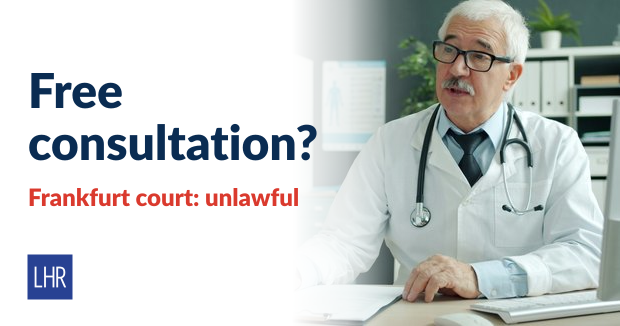 Anyone who advertises medical treatments with a promise of a “100% free consultation” is, in the eyes of the law, giving away a medical service. The Higher Regional Court of Frankfurt am Main has prohibited an online platform for obesity treatments from advertising in this way. According to the court, the exemption for “information or advice” in the German Therapeutic Products Advertising Act does not apply where the consultation itself is the main service.
Free initial consultation, no-obligation preliminary talk, free check-up: such offers are standard in many industries. In healthcare, stricter rules apply. In a judgment of 3 September 2026 (case no. 6 U 60/26), the competition law senate of the Higher Regional Court of Frankfurt am Main (Oberlandesgericht Frankfurt am Main, OLG Frankfurt) held that a free medical consultation linked to the marketing of medical obesity treatments is a prohibited inducement under the German Therapeutic Products Advertising Act (Heilmittelwerbegesetz, HWG) and therefore an unfair commercial practice. The court announced the decision in a press release on 22 October 2026.
The key points:
- Advertising a free consultation on specific obesity treatments violates the ban on inducements in Section 7(1) HWG.
- The public understands such advertising as an offer of a free medical consultation, not as information provided by service staff.
- In the court’s view, the exemption for inducements that “consist in the provision of information or advice” only covers advice as an ancillary service. Where the medical consultation is the main service, the ban applies.
- The decision was handed down in interim injunction proceedings and cannot be appealed. A court could decide differently in main proceedings.
Overview
- What was the case about?
- Why is a free consultation a prohibited inducement?
- How do patients understand advertising for a “free consultation”?
- Why does the exemption for “information or advice” not apply?
- Is the question now settled?
- What does the judgment mean for clinics, practices and health platforms?
- Frequently asked questions about advertising free medical consultations
- Further information
What was the case about?
Two competitors in the market for obesity therapies faced each other in court. The applicant develops and markets medical services for the treatment of obesity, including gastric reduction procedures and weight-loss treatments. The respondent advertises similar services via an online platform. In doing so, it highlighted a free consultation directly linked to the initiation of specific treatments. The advertising stated, among other things, that “the weight specialists at (…) will be happy to advise you on the treatment options”.
The applicant applied for a preliminary injunction. The Regional Court of Frankfurt am Main (Landgericht Frankfurt am Main) dismissed the application in a judgment of 20 March 2026 (case no. 3-10 O 14/26). The appeal before the 6th Civil Senate succeeded: the Higher Regional Court prohibited the advertising.
Why is a free consultation a prohibited inducement?
Because it is a benefit with a monetary value that the recipient does not have to pay for. Section 7(1), first sentence, HWG prohibits offering, announcing or granting “gifts and other promotional items (goods or services)” unless one of the statutory exemptions applies. The term is broad. According to the senate, it covers any monetary advantage that, from the recipient’s perspective, is not charged for.
A medical consultation is a service that is normally provided only against payment. Anyone who gives it away as part of advertising for a treatment attracts patients with an advantage that should have nothing to do with the actual treatment decision. This is exactly the kind of improper influence the ban on inducements is meant to prevent: the decision to undergo a medical procedure should be based on necessity and quality, not on promotional gifts.
The HWG applies because the advertising relates to treatments for the elimination or alleviation of a disease (Section 1(1) no. 2 HWG). The senate emphasised that the case did not concern cosmetic treatments or nutritional advice, but treatments that include at least minimally invasive procedures reserved for physicians.
How do patients understand advertising for a “free consultation”?
As an offer of a free consultation with the treating physician. This interpretation was decisive for the outcome. The respondent could have argued that it merely offered a non-binding information session with trained staff. The senate disagreed: in its view, the wording does not suggest advice from non-medical staff. Anyone seeking advice on gastric reduction or another procedure expects a physician to explain the treatment options.
The term “weight specialists” reinforces this impression. It claims medical expertise. It was therefore clear that the free service promised was a medical service and not mere customer service.
Why does the exemption for “information or advice” not apply?
Because, in the senate’s view, it only covers advice as an add-on, not advice as the main service. According to the wording of Section 7(1), first sentence, no. 4 HWG, inducements are permitted if they “consist in the provision of information or advice”. Read literally, this exemption could cover any free consultation, including a medical consultation that would otherwise cost money.
The Higher Regional Court of Frankfurt considers this wording to be a drafting error by the legislature. The legislative history shows that the exemption is intended to cover inducements consisting of information or advice given as an add-on, for example instructions on the correct use of a purchased product. It therefore presupposes a merely ancillary service. A medical consultation prior to a procedure, by contrast, is an independent main service. It is therefore not covered by the exemption.
With this interpretation, the senate closes a gap that would otherwise be wide open. Without it, providers of medical services could give away the most valuable part of their medical work, namely diagnosis and treatment recommendation, as a promotional gift and rely on a provision intended for minor usage instructions.
Is the question now settled?
No. The decision was handed down in interim injunction proceedings and cannot be appealed. The Higher Regional Court itself points out that a court may reach a different conclusion in main proceedings. Interpreting Section 7(1), first sentence, no. 4 HWG as a drafting error raises a legal question of fundamental importance. Should main proceedings follow, a ruling by the German Federal Court of Justice (Bundesgerichtshof, BGH) would be conceivable.
For practitioners, the judgment nevertheless sends a clear signal. Anyone advertising free medical consultations must expect a preliminary injunction, at least within the district of the Higher Regional Court of Frankfurt. Other courts will have to engage with the senate’s reasoning.
What does the judgment mean for clinics, practices and health platforms?
Anyone advertising medical treatments should now review free offers relating to medical consultations. Providers of obesity treatments are not the only ones affected. The reasoning can be applied to many areas in which platforms and clinics attract patients with a free initial consultation, such as hair transplants, laser eye surgery, orthodontic aligner therapy or telemedicine services. Whether the outcome is the same in an individual case depends on whether the HWG applies and how the advertising is understood.
The following steps are recommended when reviewing your own advertising:
- Record your advertising claims: Check your website, landing pages, social media ads, comparison portals and newsletters for wording such as “free consultation”, “free initial meeting” or “EUR 0 preliminary talk”.
- Clarify the type of consultation: Is a medical consultation on specific treatments being announced, or merely organisational information on procedure, appointments and costs? The more the advertising emphasises medical expertise, the more likely the public will understand it as a medical service.
- Check whether the HWG applies: If the advertising relates to the treatment of diseases or to surgical cosmetic procedures, the HWG applies.
- Adjust the design: Instead of a free service, factual information on treatment options, procedure and costs can be offered. Models such as “consultation fee will be credited against the treatment” should be reviewed separately before use, as they too may constitute a monetary advantage.
- Be prepared for warning letters: A violation of Section 7 HWG is at the same time a breach of competition law under Section 3a of the German Act against Unfair Competition (Gesetz gegen den unlauteren Wettbewerb, UWG). Competitors and associations can demand that it cease. The advertising can also be punished as an administrative offence under Section 15(1) no. 4 HWG.
Conversely, the case shows how competitors can defend themselves. After its application was dismissed by the Regional Court, the applicant did not give up and succeeded at second instance. Anyone in the healthcare market who sees a competitor attracting patients with free services can take action in interim proceedings, provided they act quickly enough.
Frequently asked questions about advertising free medical consultations
May a clinic advertise a free initial consultation?+
What is an inducement under the HWG?+
Does the exemption for “information or advice” not cover every consultation?+
Is the judgment final?+
What are the consequences of violating the ban on inducements?+
Do you advertise a free consultation, or does a competitor?
We review your healthcare advertising for risks under the HWG and the UWG, or take action on your behalf against unlawful advertising by competitors. You will usually receive an initial assessment within 24 hours.
Further information
- Federal Court of Justice prohibits advertising for telemedicine (in German)
- Federal Court of Justice: promotional gifts for prescription medicines are anti-competitive (in German)
- The end of the free second pair of glasses: Federal Court of Justice bans advertising (in German)
- Minimally invasive cosmetic procedures: Higher Regional Court of Cologne confirms ban on before-and-after images (in German)
- Our fields of activity
- Our successes
Related posts


Multiple awards.