Not David versus Goliath: why Ritter Sport’s lawsuit was no reputational trap
Your contact person

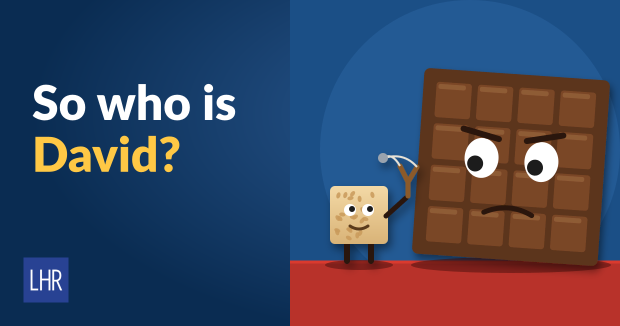 When the Regional Court of Stuttgart dismissed Ritter Sport’s action against the oat bar “Monnemer Quadrat” in January, the roles were quickly cast: here the well-known chocolate maker, there the small company from Mannheim.
On 5 November 2026 the Higher Regional Court reversed that judgment. A good moment to take another look at the story of the embattled David, and to ask whether enforcing a trade mark really harms its owner’s reputation.
By judgment of 5 November 2026 (case no. 2 U 3/26), the Higher Regional Court of Stuttgart (Oberlandesgericht Stuttgart) allowed Ritter Sport’s appeal and set aside the dismissive judgment of the Regional Court of Stuttgart (Landgericht Stuttgart) of 13 January 2026 (case no. 17 O 192/25). According to the court’s press release, the Mannheim company Wacker may no longer sell its two organic oat bars in the square packaging at issue and owes information, damages, a recall and reimbursement of legal costs.
We have already set out the details of the decision in our German article “Ritter Sport gegen „Monnemer Quadrat“: OLG Stuttgart sieht Formmarke durch Haferriegel-Verpackung verletzt” (in German). This piece is about something else, namely the narrative that has accompanied the case since the first-instance judgment.
Overview
The Higher Regional Court corrected the first instance, and clearly so
The Regional Court had found neither a likelihood of confusion nor any exploitation of the reputation of a well-known mark. Chocolate bars, it said, are a sweet, whereas a muesli bar is an energy snack with a healthy image, and the advertising slogan did not matter because it was not part of the subject matter of the dispute.
The 2nd Civil Senate did not share that assessment. It considered the goods to be of average similarity, the packaging to be of above-average similarity and the distinctive character of the shape mark to be very high, and therefore found a likelihood of confusion under Section 14(2) no. 2 of the German Trade Mark Act (MarkenG).
In our view, the second part of the reasoning carries more weight. Under Section 14(2) no. 3 MarkenG, which protects marks with a reputation, the Senate found an unfair exploitation of the distinctive character of the mark, since the square exerts a pull into which the oat bar maker had placed itself. The court regarded the slogan “Quadratisch. Kokos. Klar.” as a recognisable allusion to the decades-old “Quadratisch. Praktisch. Gut.” (“Square. Practical. Good.”), and it was precisely this slogan that the Regional Court had still considered irrelevant.
Who exactly is David here?
After the Regional Court’s judgment, a good deal of sympathy for the Mannheim manufacturer could be read in legal commentary and on social media. The famous chocolate maker against a small company, and a bar that is not even chocolate: the story almost writes itself, and it was written readily. We saw the case differently even then.
The roles are less clear-cut than the narrative suggests. Wacker did not stray into the vicinity of the best-known packaging shape on the German confectionery shelf by accident. It called a square product “Monnemer Quadrat” and advertised it with a slogan that barely disguises its borrowing from Ritter Sport.
Incidentally, the company has used the dispute itself rather skilfully for its own marketing. According to the report by LTO, an elongated “Monnemer Klageriegel” (roughly, “Monnemer lawsuit bar”) has now replaced the square. Anyone who first seeks proximity to someone else’s mark and then exploits the dispute in advertising does not quite fit the role of the victim.
Both companies want to sell their bars, both act commercially, and company size alone does not create a moral gradient. The smaller supplier is not in the right because it is smaller, and the owner of a well-known mark is not in the wrong because it defends its registered rights.
Is suing a smaller competitor a reputational trap?
Behind the narrative lies a question we regularly encounter in our advisory work: should a well-known company take action against a small competitor when it is foreseeable that the public will side with the smaller party? Any enforcement step can trigger reactions, and with a brand everyone knows from the supermarket they will be louder than with a maker of industrial screws. Concluding from this that bringing the action was in itself a lack of proportion, however, confuses the risk of bad press with a reproach to the claimant.
In our view, framing the matter as “trade mark protection versus reputation protection” therefore falls short. A mark its owner does not defend loses distinctiveness over time, particularly a shape mark whose value lies in the fact that the square on the shelf is associated with one manufacturer only. Ritter Sport has defended the square for years, against Milka before the Higher Regional Court of Cologne and in cancellation proceedings up to the Federal Court of Justice (Bundesgerichtshof, BGH). We reported at the time on the dispute with Milka over the twin pack (in German) and on the BGH decision on the protectability of the square (in German). This has little to do with a campaign against the small and a great deal to do with brand maintenance.
The fact that the Regional Court initially dismissed the action said little about whether bringing it was justified. The Higher Regional Court of Stuttgart has had occasion to correct first-instance decisions before, and it did so here. The Senate did not grant leave to appeal on points of law, but Wacker may lodge a complaint against the denial of leave with the BGH within one month of service and has already announced that it will do so. The judgment is therefore not yet final.
What brand owners and imitators should take away
For companies that own a well-known design, and for those wishing to borrow from one, the proceedings offer several lessons:
- A shape mark protects even where name, colour and logo differ. A different brand name on the pack helps little if the shape of the packaging itself creates the link to the well-known mark.
- Slogans alluding to a well-known slogan will be used against the party making the allusion. What marketing considers a wink, a court reads as evidence of deliberate approximation.
- Anyone acting against an imitation should plan for the public reaction, but should not be deterred by it. Factual, comprehensible communication about one’s own action protects reputation better than silence.
- Before entering the market with eye-catching packaging, it is worth searching for registered three-dimensional marks, not only for word marks and logos.
The “Klageriegel”, by the way, is elongated. One may see it as belated insight or as the next punchline; square it is not, at any rate.
Frequently asked questions about the “Monnemer Quadrat” trade mark dispute
What did the Higher Regional Court of Stuttgart decide in the dispute between Ritter Sport and the “Monnemer Quadrat”?+
Can packaging without any lettering be protected as a trade mark?+
Does enforcing trade marks against smaller competitors damage a company’s reputation?+
Does a different brand name on the pack protect against a trade mark infringement claim?+
Is the judgment of the Higher Regional Court of Stuttgart final?+
Is your brand being imitated, or have you received a warning letter from a trade mark owner?
We assess your position under German trade mark and competition law and tell you openly whether action is worthwhile and how it will be perceived. You will usually receive an initial assessment within 24 hours.
Further information
- Ritter Sport gegen „Monnemer Quadrat“: OLG Stuttgart sieht Formmarke durch Haferriegel-Verpackung verletzt (in German)
- Higher Regional Court of Stuttgart, press release of 5 November 2026 (in German)
- Das Quadrat ist eine Marke (in German)
- Our fields of activity
- Our successes
Related posts







Multiple awards.