Checking a brand name before filing: LHR Markencheck now queries the German register live
Your contact person

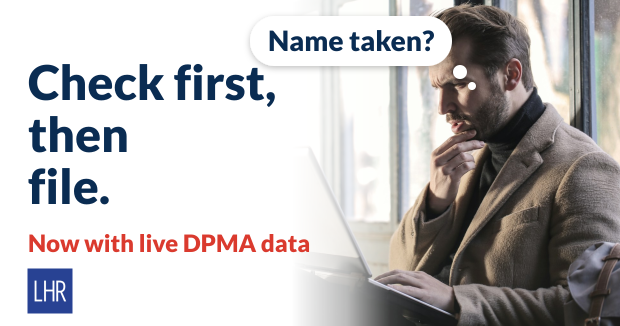 Anyone looking for a name for a product, a practice or a company faces two questions: can the name become a trade mark at all, and is someone else already using it? The free LHR Markencheck answers both in one step, and since 21 October 2026 it queries the official register of the German Patent and Trade Mark Office directly. What the check does, where its limits are and when a lawyer should take a look.
Most name searches on the internet only deal with the second question. They search a register for identical or similar names and report “available” or “taken”. Whether the name clears the hurdles of trade mark law in the first place, they do not say. Yet that is exactly where many applications fail in practice: the office refuses the name because it merely describes the goods or services or lacks distinctive character. Other applications pass the office and fail months later because of an opposition or a cease-and-desist letter, when the logo, packaging and website have long been paid for.
The LHR Markencheck therefore addresses both points:
- It assesses registrability against the absolute grounds for refusal under Section 8 of the German Trade Mark Act (Markengesetz, MarkenG) and Article 7 of the EU Trade Mark Regulation (EUTMR).
- It queries German marks live in the register of the German Patent and Trade Mark Office (Deutsches Patent- und Markenamt, DPMA) and EU trade marks in the register of the European Union Intellectual Property Office (EUIPO), in each case including international registrations designating Germany or the EU.
- It searches for identical spelling, similar sound and the name as an element of earlier marks.
- It suggests suitable Nice classes and shows whether the .de domain is still available.
- It is free, requires no account, and the result is not stored.
Overview
- What does the office examine when a trade mark is filed – and what not?
- Why do so many names fail on registrability?
- What is new about the LHR Markencheck?
- How does the check identify similar marks?
- Where are the limits of an automated check?
- Quick check, Eigenregie or lawyer: which fits when?
- What does this mean for founders and businesses?
- Frequently asked questions about the LHR Markencheck
- Further information
What does the office examine when a trade mark is filed – and what not?
The office only examines whether the name can be registered as a trade mark, not whether earlier marks stand in the way. Under Section 37 MarkenG, the DPMA examines the absolute grounds for refusal only. Earlier rights of third parties play no part in the registration procedure. It is up to the owners of earlier marks to defend themselves.
Their main tool is the opposition. Against a German mark it must be filed within three months of publication of the registration (Section 42 MarkenG); against an EU trade mark within three months of publication of the application (Art. 46 EUTMR). For EU trade marks the EUIPO does draw up a search report on earlier EU marks, but it does not refuse an application on that basis. Once the opposition period has expired, the owner of the earlier right can still apply for a declaration of invalidity and, above all, claim injunctive relief under Section 14 MarkenG.
It is also risky to assume that a mere application does no harm. According to the case law of the German Federal Court of Justice (Bundesgerichtshof, BGH), the filing of a trade mark as a rule gives rise to the risk that the sign will be used for the goods and services applied for. This risk of first infringement does not simply disappear if the applicant later stops pursuing the application (BGH, judgment of 22 January 2014, I ZR 71/12 – REAL-Chips). Anyone who files blindly can therefore receive a cease-and-desist letter before selling a single product.
Why do so many names fail on registrability?
Because they describe the offer instead of pointing to the provider. A trade mark is meant to show the commercial origin of goods or services. Names that merely say what is offered, what it is like or what it is for are excluded from registration under Section 8(2) nos. 1 and 2 MarkenG. They must remain available to all competitors.
The line is drawn not by the word but by the offer. “Apple” is a strong mark for computers; for fruit it would be a generic term. That is why the Markencheck asks not only for the name but also for what is to be offered under it. How strict the standards are is shown by decisions such as “Biomarkt” (in German) or the BGH’s refusal of “Kölner Dom” (in German).
For EU trade marks the hurdle is even higher. Under Art. 7(2) EUTMR, it is sufficient that a ground for refusal exists in only part of the Union. A name that describes the product in any of the official languages of the EU is therefore refused as a whole. The Markencheck takes this into account when the EU is selected as the territory.
What is new about the LHR Markencheck?
What is new is the direct query of the German register. Until now, the check could only cover earlier German marks through a link to a manual search, because the EUIPO interface provides EU trade marks only. Since 21 October 2026, the check queries the DPMA register via DPMAconnectPlus, the DPMA’s official data access service. The query runs in real time for every check. Cancelled, refused and withdrawn marks are filtered out.
Registrability is assessed by artificial intelligence that we have aligned with the criteria of Section 8 MarkenG and Art. 7 EUTMR and with the case law of the BGH, the EU General Court and the Court of Justice of the European Union. After about 30 seconds the result appears as a report with two traffic lights, one for registrability and one for the register situation, together with a recommendation: file, adapt the name or have the situation examined more closely before filing.
You need neither an account nor an e-mail address for the check. With your consent, the name and the description of your offer are transmitted to the AI system Claude by Anthropic and sent as a search term to the DPMA and the EUIPO. The result is not stored.
How does the check identify similar marks?
By spelling, sound and elements. Under Section 9(1) no. 2 MarkenG, whether two marks can be confused depends on three interdependent factors: the similarity of the signs, the similarity of the goods and services and the distinctiveness of the earlier mark. For the signs to be similar, it is enough that the names resemble each other in sound, appearance or meaning.
How readily courts find similarity is illustrated by the General Court’s decision on “kaufdas.online” (in German), which was not registered as an EU trade mark because of its proximity to “Kaufland”. Sound is often underestimated. The Markencheck therefore compares not only letters but also pronunciation. For this it uses the Kölner Phonetik, a method that encodes German words according to how they sound, and a measure of the distance between spellings. Earlier marks in the same or neighbouring classes are weighted more heavily than marks for entirely different goods.
The free check shows the closest hits. Whether one of them is actually dangerous depends on the list of goods and services of the earlier mark. That comparison is provided by the Eigenregie similarity search for EUR 99 net, which also searches numerous spelling, sound and meaning variants.
Where are the limits of an automated check?
The check is an initial assessment, not a legal review. It works with what is in the registers and cannot see certain rights:
- Logos and figurative marks cannot be found by a name search. Only a similarity search by a lawyer covers them.
- Company names and work titles arise through use, without registration, under Section 5 MarkenG. An earlier company name can stand in the way of a new mark but appears in no trade mark register. The Eigenregie search therefore also searches the internet for companies, products and apps with the same name.
- Actual use is not shown in the register. An earlier mark that has not been used for more than five years may be liable to revocation (Section 49 MarkenG). A red hit can then turn into an opportunity.
- The distinctiveness of the earlier mark and how narrowly its specification is to be read require an assessment of the individual case.
From LHR’s practice
A hit in the register does not have to be the end of a name, as a case from our practice shows: a client wanted to file a new mark for a broad range of goods, and the search revealed three earlier marks that were very similar in sound and appearance. Closer examination showed that two of them had probably not been used for years, and in the case of the third there were indications of a repeat filing to circumvent the use requirement. Details can be found in our article “Ältere Marken gefunden? Warum eine gründliche Recherche erst der Anfang ist” (in German).
Quick check, Eigenregie or lawyer: which fits when?
That depends on how much rides on the name and whether you want to file yourself.
The free quick check is suited to the early phase, when several names are on the shortlist and weak candidates need to be weeded out. Those who do not yet have a name receive three pre-checked suggestions from the name finder.
The Eigenregie similarity search is aimed at entrepreneurs and founders who want to file themselves. It is generated fully automatically within a few minutes, compares the specifications of similar EU trade marks with your offer, checks six domain extensions and companies with the same name, and provides a draft of classes and specification with instructions for filing yourself. It costs EUR 99 net for one name and EUR 149 net for two names compared side by side. It is not reviewed by a lawyer.
Filing through a lawyer is the right route if the check shows amber or red, if a business launch, a product launch or a larger investment depends on the name, or if the mark is to be valid in the EU. We examine the sign, draft the specification, file with the DPMA or the EUIPO and represent you in the application proceedings, at a fixed price from EUR 349 net for Germany and from EUR 549 net for the EU, plus official fees. If you instruct us within 60 days for the same mark with a similarity search by a lawyer or with the Abgesichert or Begleitet package, we credit the price paid for the Eigenregie search once.
What does this mean for founders and businesses?
Anyone who wants to build a name should check it before putting money into it. In practice we recommend:
- Check early: Check the name before the logo, domain, packaging and commercial register entry, not afterwards.
- Describe the offer specifically: Registrability depends on what the name is to stand for. The more precise the description, the more reliable the result.
- Take amber and red seriously: A similar hit in the same class is a reason to look more closely, not a detail.
- Do not file blindly: The application alone can trigger a claim for injunctive relief. The official fee is lost if the mark is cancelled following an opposition.
- Draft the specification carefully: Only what is in the list of goods and services is protected. It cannot be extended after filing.
- Monitor after registration: The offices do not report conflicting new applications. Anyone who misses the opposition period must rely on the more expensive cancellation proceedings.
Frequently asked questions about the LHR Markencheck
Is the LHR Markencheck free of charge?+
Which registers does the Markencheck search?+
Is a green result enough to file?+
Why does the DPMA not examine earlier marks itself?+
What happens to my input?+
Planning to protect a brand in Germany or the EU?
Check your name free of charge with the LHR Markencheck (in German) or have our specialist lawyers for intellectual property examine and file it directly. You will usually receive an initial assessment within 24 hours.
Further information
Multiple awards.