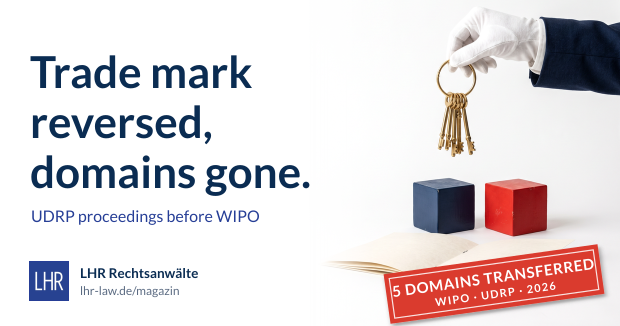
LHR case study: UDRP proceedings against a reversed trade mark – five domain names transferred
Your contact person

 A competitor simply reverses the two word elements of a German trade mark, secures five matching domain names and argues that its business existed long before it ever came to Germany.
In UDRP proceedings before WIPO, that was not enough. All five domain names go to our client – and the decisive evidence came, of all places, from the other side’s own archived web pages.
Overview
- UDRP proceedings against a reversed trade mark: the case
- What are UDRP proceedings and when are they worthwhile?
- The other side’s argument: we were here first
- Why did the 2024 registration date not matter?
- Bad faith: whoever enters the same market knows the competition
- In parallel before a German court: two proceedings, two objectives
- What trade mark owners in the same situation can do
- Frequently asked questions about UDRP proceedings
- Further information
UDRP proceedings against a reversed trade mark: the case
Our client, a German service company in the field of digital media, has for years owned a German word mark made up of two terms that are each descriptive on their own. To stay with an illustration, imagine a mark along the lines of “PhotoTown”. The client has offered its services in Germany under this mark and a matching domain name for several years.
At some point a provider appeared offering the same services as “TownPhoto”, using the same two elements in reverse order. The corresponding domain names were held with a registrar in the United States and registered to a private individual and his company:
- the main .com domain, registered in early 2024 and hosting the actual website,
- three further domain names from 2025, including a .net version and two variations with added terms,
- and a fifth domain name that matched our client’s mark except for one inserted letter – in the correct order.
All secondary domains redirected to the main site, which by then was clearly aimed at German customers: a German-language version, prices in euros and a contact in Berlin for the DACH region (Germany, Austria, Switzerland).
In August 2026 we filed a complaint on our client’s behalf with the Arbitration and Mediation Center of the World Intellectual Property Organization (WIPO). In November 2026 the sole panelist ruled that all five domain names are to be transferred to our client.
What are UDRP proceedings and when are they worthwhile?
UDRP proceedings are a written dispute resolution procedure under ICANN’s Uniform Domain-Name Dispute-Resolution Policy (UDRP), to which every holder of a .com, .net or other generic domain name agrees in its registration agreement. The trade mark owner has to show three things: the domain name is identical or confusingly similar to its mark, the holder has no rights or legitimate interests in it, and it was registered and is being used in bad faith. If that succeeds, the panel orders the domain name to be transferred or cancelled.
The appeal of the procedure lies in the fact that it needs no court jurisdiction, no service abroad and no enforcement proceedings. The registrar implements the decision itself. Anyone dealing with a domain holder in the United States, in the Seychelles or behind a privacy service saves a great deal of trouble. Damages or an injunction against use of the sign are not available, of course; those remain a matter for national courts.
The UDRP does not apply to German .de domains. There, a dispute entry with DENIC, the German registry, and if necessary a German court are the way forward, as described in our German-language article on an unlawfully transferred domain (in German).
The other side’s argument: we were here first
The response to the complaint did not come from the registered domain holder but from another US company. It argued that it had taken over the entire business, including the domain names, name, logo and goodwill, by written assignment agreement in autumn 2025 from the original company, which was dissolved a few weeks later. The registrar records, it said, had simply not been updated by mistake.
On the merits, the other side relied on four points. The name consisted of two descriptive English words describing exactly what was offered. Our client’s mark was registered only in Germany, whereas the main domain had been registered back in early 2024 by an American business with no connection to Germany. The original registration date was decisive because the assignment was merely the continuation of the same business. And finally, the dispute belonged before the German court that we had seised in parallel anyway.
On top of that, the other side asked the panel to find that our client had brought the complaint abusively – “Reverse Domain Name Hijacking” in UDRP terms. The trade mark search for the two terms that it submitted in support, incidentally, returned our client’s mark as its very first hit.
Why did the 2024 registration date not matter?
Where a domain name changes hands, WIPO panels generally assess bad faith as of the date on which the new holder acquired control (WIPO Overview 3.1, section 3.9). The only exception is a purely formal change within an unbroken chain of ownership. The other side could not establish such a chain – quite the opposite: its own website showed that it had controlled the main domain months before the alleged assignment agreement.
The panel reviewed the archived versions of the main domain in the Wayback Machine itself. In late January 2025 the website still showed a US telephone number and prices in dollars; a few days later the number had disappeared and the prices were stated in euros. The privacy policy, dated the end of January 2025, named the owner of the company that later appeared in the proceedings as the person responsible and referred to the GDPR and to German and Swiss law, without any mention of US law. By summer 2025 the imprint identified that company as the service provider, and the general terms and conditions provided for German law.
There was, by contrast, no evidence of a transfer of the ongoing US business apart from the agreement itself – no clients, contracts, employees or receivables. The registrar data remained unchanged for more than a year, and one of the domain names was still registered to the original company’s owner after that company had been dissolved. The other side had expressly asked the panel to look at substance rather than form. The panel did just that, only with a different result than the other side had hoped for: the relevant date for the main domain was the takeover at the end of January 2025, and for the other domain names their respective registration dates.
Bad faith: whoever enters the same market knows the competition
At the time of the takeover, our client had been active on the German market under its mark for more than five years. Both sides work in the same, fairly small industry, and the other side’s Berlin contact itself offers comparable services. The panel found it unlikely that the other side had overlooked the only competitor with an almost identical name before turning to the German market. The two terms may be descriptive individually, but their combination is not an everyday word, least of all on the German market.
The fifth domain name did the rest. It matched our client’s mark, including the word order, except for one letter, and redirected to the other side’s website. The explanation that this was a defensive registration of variants of the respondent’s own name failed for the simple reason that the domain did not vary the respondent’s own name, but our client’s.
The panel saw two possible explanations: either the other side had wilfully disregarded our client’s rights, or it intended to exploit its reputation to draw customers to its own website. Given the targeted orientation towards Germany, the domain names registered later and the redirects, it considered the second more likely. That is the classic case of bad faith under paragraph 4(b)(iv) of the UDRP. A legitimate interest based on earlier bona fide business use under paragraph 4(c)(i) of the UDRP was therefore ruled out, even though the panel did accept genuine commercial activity in the United States before the dispute. The request for a finding of Reverse Domain Name Hijacking was rejected.
At the first stage, incidentally, there was nothing to discuss. Reversing the word order, adding “pro” or inserting a letter does not change the fact that the mark remains recognisable in the domain names. The other side did not even dispute confusing similarity within the meaning of the UDRP.
In parallel before a German court: two proceedings, two objectives
Alongside the UDRP proceedings, we applied on our client’s behalf to a German Regional Court (Landgericht) for a preliminary injunction against the German partner company and its managing director. The other side argued that this made the UDRP proceedings superfluous and that the dispute belonged exclusively before the German court. The panel disagreed: the parties are different, so is the subject matter, and the court decides on trade mark infringement in Germany, not on the transfer of domain names.
The Regional Court has since granted the preliminary injunction in part. It found a likelihood of confusion between the two names within the meaning of Section 14(2) no. 2 of the German Trade Mark Act (MarkenG) and prohibited the partner company and its managing director from using the sign for the relevant services in Germany. It rejected the application concerning the domain names because it had not been sufficiently shown that the partner company in particular controls them. The judgment is not final.
It is precisely this part that shows why the two routes complement each other. A court can only order the party to whom the domain is demonstrably attributable, and who is behind a domain often cannot be established in summary proceedings when companies are nested. A UDRP decision, by contrast, is directed against the registered holder and implemented by the registrar, regardless of which company currently claims to be pulling the strings.
What trade mark owners in the same situation can do
Anyone who finds a competitor operating with a modified or reversed version of their mark and matching domain names should not wait long. Our case suggests a few practical points:
- Preserve web pages: document the other side’s imprint, terms and conditions, privacy policy and prices in the Wayback Machine and by screenshot. The opponent’s own documents often reveal most clearly which market it is targeting.
- Cover all variants: a single UDRP complaint can cover several domain names of the same holder. It is often the inconspicuous secondary domain that proves intent.
- Privacy services are no obstacle: at WIPO’s request, the registrar discloses the actual holder, and the complaint is then amended.
- Respond to new submissions: if the other side only produces, say, an assignment agreement in its response, a supplemental filing is possible. The panel admitted ours because it addressed exactly that.
- Watch the deadline: the registrar implements the transfer unless the holder shows within ten business days of notification of the decision that it has commenced a lawsuit against it (paragraph 4(k) UDRP). In our case this period is currently running.
Reversing a trade mark does not make it your own. And anyone who runs their website like a German company should not be surprised when a panel treats them as one.
Frequently asked questions about UDRP proceedings
Which domain names are covered by UDRP proceedings?+
How long do UDRP proceedings before WIPO take?+
Is reversing the elements of a trade mark enough to avoid it?+
Does buying an older domain together with a business protect against a finding of bad faith?+
Can you go to a German court in addition to UDRP proceedings?+
Is a competitor using domain names confusingly similar to your trade mark?
We assess whether UDRP proceedings, a DENIC dispute entry or a preliminary injunction is the right route, and pursue it for you. You will usually receive an initial assessment within 24 hours.
Further information
- Trademark law
- Resolute pursuit of trademark law violations
- Domain grabbing: how to get a stolen domain back (in German)
- Regional Court of Düsseldorf prohibits unlawful domain redirection by a competitor (in German)
- Our fields of activity
- Our achievements
Related posts





Multiple awards.