LHR Case Report: When Criminal Complaints Become Ammunition for the Press – Why Media Law Sometimes Starts with the Public Prosecutor
Your contact person

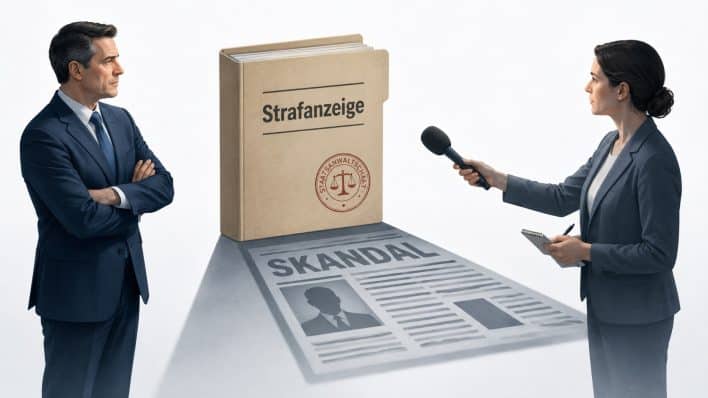 How a mere criminal complaint can be turned into an apparently official suspicion – and why effective reputation protection sometimes begins before the first article is published.
Anyone defending against unlawful reporting based on suspicion should not wait until the article has already appeared.
That sounds obvious. In practice, it is often overlooked.
The real danger does not always lie in the finished article. Sometimes it arises earlier: with the press inquiry, with the source of the alleged suspicion, with a criminal complaint against unknown persons – and sometimes with the question of what exactly a public prosecutor’s office has confirmed to a newsroom.
The classic reaction is not enough
When companies, board members or other exposed individuals are confronted with an impending press publication, the immediate focus is usually on the media outlet.
What does the editorial team intend to report? What questions are being asked? What allegations are being made? What statement should be issued? Are injunctions, corrections or other legal steps required?
That approach is correct. But it is not always sufficient.
Modern reporting based on suspicion often works indirectly: first, a criminal complaint is filed, information is submitted to an authority, or a matter is placed before a public body. The very existence of that process is then used journalistically.
Something that was initially merely alleged, initiated or strategically staged suddenly becomes an apparently objective reporting event.
The headline is no longer: “Someone is making an allegation.”
It becomes: “The public prosecutor is dealing with the matter.”
That sounds far more serious. And that is precisely the problem.
The artificially created subject of reporting
In a recent LHR mandate, the issue was a press inquiry concerning an alleged case of document forgery. A criminal complaint against unknown persons was said to exist. The inquiry gave rise to the concern that the mere existence of a criminal complaint was to be turned into a newsworthy suspicion.
For the affected clients, one point was crucial: they were not aware of any corresponding investigation. Nevertheless, they faced the risk of reporting that could rely on the appearance that a criminally relevant matter existed at the public prosecutor’s office.
This is precisely where effective media-law reputation protection begins.
LHR did not only address the journalistic side. We also contacted the competent public prosecutor’s office directly. The aim was to clarify the actual status of the matter and, at the same time, to draw attention to the strict limits that apply to information provided by prosecuting authorities to the press.
Why a civil-law media practice communicates with the public prosecutor
A civil-law firm focusing on media law and reputation protection does not conduct criminal investigations. Nor does it act as criminal defence counsel against an accusation that may not even have been properly established.
But it must prevent a mere complaint, a tactically created contact with an authority or one-sided information from turning into a reputationally damaging anchor of suspicion.
This becomes particularly problematic where third parties – opponents, competitors, former business partners, interested informants or even media actors themselves – seek to create or amplify the subject of later reporting by deliberately providing information to authorities.
From a media-law perspective, this mechanism is dangerous.
A criminal complaint is, initially, nothing more than a complaint. It proves nothing. It does not mean that there is a criminal suspicion. It does not mean that an investigation is being conducted against a specific person or company. And it certainly does not, without more, justify identifying reporting.
The public prosecutor as an involuntary amplifier
Statements from a public prosecutor’s office carry particular weight in public perception. When an authority confirms something, it sounds official. For that reason, even brief statements can have serious reputational consequences.
The danger lies in journalistic translation.
“A complaint has been received” quickly becomes, in the mind of the reader: “There must be something to it.”
In the context of identifying reporting, “against unknown persons” may effectively become a suspicion directed at a specific company or individual.
That is why restraint is essential. This applies not only to journalists, but also to public authorities. The presumption of innocence is not a decorative principle for criminal-law textbooks, but a practical safeguard against public prejudgment.
Successful clarification by the public prosecutor’s office
In the specific case, following LHR’s intervention, the public prosecutor’s office confirmed that it had merely confirmed to a journalist that a criminal complaint filed by a lawyer against unknown persons on suspicion of document forgery had been received.
The further clarification was particularly important: neither the content of the complaint nor the specific allegations or persons involved had been the subject of the information provided. The allegations and accusations underlying the requested article had also not been communicated by the press office of the public prosecutor’s office.
This is significant from a media-law perspective.
It prevents a possible journalistic account from hiding behind an allegedly officially confirmed factual basis.
If the public prosecutor merely confirms the receipt of a complaint against unknown persons, that does not confirm,
- that the complaint is substantively reliable,
- that a specific person or company is suspected,
- that an investigation is being conducted against a specific individual,
- or that the authority shares the alleged accusations.
Reporting based on suspicion requires more than a complaint
For years, LHR has pointed out in its magazine that reporting based on suspicion is lawful only under strict conditions. These include, in particular, a minimum basis of evidentiary facts, a fair opportunity to comment, careful research, balanced reporting and language that does not present the suspicion as an established fact.
Further information can be found in our articles:
- Requirements for lawful reporting based on suspicion
- German Federal Court of Justice: Identifying reporting based on suspicion only where there is a minimum basis of evidentiary facts
- Reporting based on suspicion: overview and five practical tips for bloggers and journalists
A criminal complaint may be part of journalistic research. But it does not replace research.
It is not evidence. It is not an official confirmation. It is not a licence to publish a report that leaves the public with the impression that a company or individual is practically already under criminal suspicion.
The familiar pattern: start the fire, then report on the flames
Cases become particularly problematic where the subject of reporting does not arise independently, but is first created through targeted conduct.
Anyone who files a criminal complaint, submits information to authorities or provokes official processes may later attempt to exploit precisely that self-initiated dynamic in the media.
The pattern is simple:
- First, a matter is placed before an authority.
- Then the authority is asked whether the matter exists.
- Finally, the report states that an authority is dealing with the matter.
For the average reader, what often remains is not the fact that the matter may initially be nothing more than a complaint, an allegation or one-sided information.
What remains is: public prosecutor. Document forgery. Investigation. Suspicion.
This kind of shortcut is dangerous. It can damage livelihoods, market values, contractual relationships, credit lines and personal reputation before it has even been clarified whether there is any substance to the allegation.
This case is not an isolated one
LHR has recently reported several times on media-law disputes concerning the limits of lawful reporting based on suspicion.
By decision of 26 February 2026, case no. 15 W 7/26, the Higher Regional Court of Cologne prohibited manager magazin and several responsible editors, by way of interim injunction, from reporting on certain matters concerning a listed company and its CEO.
- Higher Regional Court of Cologne prohibits manager magazin from reporting on TPG
- Interim injunction proceedings and lawsuit against manager magazin
- Further interim injunction against manager magazin
Those cases also concerned the central question of where legitimate press freedom ends and unlawful reporting based on suspicion begins.
The present case shows another important aspect: it is not only the finished article that matters. Often, the way in which the story was created is just as important.
Reputation protection is also communication with authorities
Professional reputation protection is not limited to warning letters, interim injunctions and requests for corrections. These instruments remain important. But they often come into play only after the damage has already occurred.
In sensitive cases, action must be taken earlier. This includes:
- quickly assessing the press inquiry,
- clarifying which alleged facts actually exist,
- communicating with the editorial team,
- examining possible court action,
- and, where authorities or public prosecutors are drawn into the reporting, communicating directly with those bodies.
This is not a confusion of criminal law and media law. It is consistent protection of personality and reputation rights.
Anyone who wants to prevent a mere complaint from being inflated into a reputationally damaging narrative must clarify the factual basis of that narrative at an early stage.
What companies can learn from this case
Companies and exposed individuals should never treat press inquiries with a criminal-law angle as a mere communication exercise.
When terms such as “criminal complaint”, “public prosecutor”, “document forgery”, “fraud”, “investigation” or “complaint against unknown persons” appear, the issue is not simply a matter of providing a few quotes for an article.
The real question is whether there is a legally sustainable suspicion – or whether an artificial subject of reporting is being constructed.
Especially for listed companies, businesses dependent on financing, or highly exposed corporate officers, the damage can be substantial. A legally imprecise but journalistically effective suspicion narrative is often enough to undermine trust.
Conclusion: The best defence begins before publication
This case illustrates why media-law defence today must be more than retrospective article criticism.
Where third parties use contacts with authorities to create reporting events artificially, a specialised law firm must identify and interrupt that mechanism early. This also includes communicating with public prosecutors in a factual, precise and legally sound manner.
Not every complaint is a suspicion.
Not every involvement of an authority is a confirmation.
And not every cloud of journalistic smoke proves that there is a fire.
Sometimes, someone has simply been very deliberate in striking the match.
Fast assistance with press inquiries involving criminal allegations
If you or your company are confronted with a press inquiry involving criminal complaints, investigations, public prosecutors or other official proceedings, the legal assessment should take place before publication.
LHR can quickly assess whether the intended reporting is permissible under German media law, what kind of response is appropriate and whether communication with authorities or public prosecutors is required.
Further information
- LHR topic page: Press law
- Dealing properly with the press
- Litigation PR: useful, lawful or unlawful?
- Removing negative reporting and reputation protection for companies
- LHR topic page: reputation management
Related posts








Multiple awards.