BGH on Paparazzi Photos: The Photographer Is Not Liable for Publication
Your contact person

 Helene Fischer has also lost her case against the paparazzo who photographed her with her baby daughter in Munich in 2022. The German Federal Court of Justice makes it clear: editors and publishers are liable for unlawful publications, not the photographer who merely offers the pictures. What this means for those affected, for businesses and for photographers.
In May 2022, the singer Helene Fischer was out in Munich’s city centre with her daughter, then only a few months old, and her mother. A photographer took pictures of the family from a considerable distance with a telephoto lens and offered them to several newsrooms. Pictures from the series were later published by RTL, bild.de and in magazines, among others. Fischer then claimed monetary compensation of at least EUR 10,000 from the photographer.
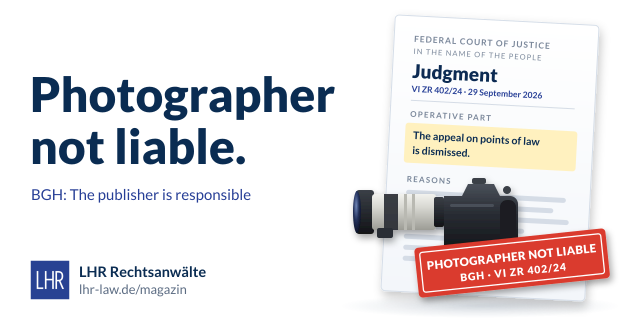
The German Federal Court of Justice (Bundesgerichtshof, BGH) has now finally dismissed the claim (BGH, judgment of 29 September 2026, case no. VI ZR 402/24). The decision is final. It follows the judgments of 21 July 2026, in which Fischer established an infringement of her rights against the publishing media but was not awarded monetary compensation. We reported on those proceedings in our article “Unlawfully photographed – and still no money for Helene Fischer” (in German).
The key points of the new judgment:
- No GDPR damages: taking and passing on the photos is journalistic data processing and falls under the media privilege.
- No liability for third-party publications: newsrooms and publishers are responsible for publication, not the photographer.
- Passing on is not dissemination: offering pictures to newsrooms is, as a rule, not dissemination within the meaning of Section 22 KUG.
- Covert photography permissible: according to the court’s balancing exercise, taking the photos was lawful.
What was the case before the BGH about?
The only question was whether the photographer himself has to answer for the pictures. Fischer had already taken action in summary proceedings against the further offering of the photos. In the main proceedings, she claimed money, relying on her general right of personality and on Art. 82 GDPR.
The lower courts took different views. The Regional Court of Berlin (Landgericht Berlin) largely granted the claim by judgment of 17 October 2023 (case no. 27 O 83/23). The Berlin Court of Appeal (Kammergericht) dismissed it by judgment of 5 December 2024 (case no. 10 U 166/23). The BGH’s Sixth Civil Senate has now dismissed the singer’s appeal on points of law.
Why does the claim under Art. 82 GDPR fail?
Because the photographer’s activity falls under the media privilege. Photos of an identifiable person are personal data, and taking and passing them on is processing within the meaning of the GDPR. However, Art. 85(2) GDPR allows Member States to provide for exemptions for processing carried out for journalistic purposes. The German federal states have made use of this. To the extent the media privilege applies, the processing does not have to be measured against Art. 6 and Art. 7 GDPR. A damages claim based on unlawful processing therefore fails.
The concept of journalism is decisive. The BGH interprets it broadly, following the case law of the Court of Justice of the European Union. The wording is “to be understood broadly”, and the concept does not only cover “quality media”. Journalistic preparation, i.e. obtaining information and pictures, is also protected. The press photographer is thus treated as an auxiliary undertaking of the press, even if he does not publish anything himself.
One limit remains: the court maintains the requirement of a minimum degree of editorial work of one’s own. Anyone who merely collects data and passes it on unfiltered cannot simply rely on the media privilege. For the paparazzo who selects subjects, photographs scenes and offers series of pictures to newsrooms, the BGH considered this threshold to be met.
Is the photographer liable for the unlawful publications?
No. The BGH confirms that the later publications were unlawful and infringed the claimant’s right of personality. There was no consent, and the pictures were not portraits from the sphere of contemporary history under Section 23(1) No. 1 KUG. However, these infringements cannot be attributed to the photographer.
The court bases this on a clear “allocation of areas of responsibility”. The newsroom decides on the publication, the accompanying text and the context. Whether a picture may lawfully be shown depends on precisely this context. One and the same photo may be permissible in a report on an event of contemporary history and impermissible in a pure entertainment piece. Consequently, the responsible editors and publishers are liable for compliance with these limits, not those who were active at an earlier stage.
Liability as an indirect disturber by analogy with Section 1004 of the German Civil Code (BGB) is also ruled out. It requires the breach of a reasonable duty to review. The lower courts had not established any special circumstances that would have obliged the photographer to carry out his own review.
Is offering pictures to newsrooms “dissemination”?
As a rule, no. Section 22 of the German Art Copyright Act (Kunsturhebergesetz, KUG) prohibits disseminating or publicly displaying portraits without consent. The BGH interprets the term dissemination narrowly here. Passing on pictures whose manner of use and specific context of publication are still unclear is, in the court’s words, a typical media-related auxiliary activity. It belongs to the sphere of journalistic preparation that freedom of the press under Art. 5(1), second sentence, of the German Basic Law (Grundgesetz, GG) expressly protects.
This is an important point in practice. An injunction against merely offering photos to newsrooms can now hardly be based on Section 22 KUG. The starting point remains the specific publication.
Was the photographer allowed to take the pictures at all?
Yes. According to the BGH’s balancing exercise, taking the pictures was already lawful. Here, freedom of the press and the photographer’s freedom to pursue his profession outweigh the right to one’s own image and the protection of privacy. There is no general ban on covert photography.
The court looks at the circumstances. Viewed without context, the pictures affected the claimant’s privacy only at its periphery. Fischer had deliberately gone out into the public space of the busy city centre, where a very prominent person has to expect to be recognised. Aspects of private life, such as the normality of everyday life, may also give rise to a legitimate public interest in information in the case of celebrities.
At the same time, the BGH stresses that photos showing a parent’s attention to their child are particularly sensitive. The protection of the depicted parent’s personality may be reinforced by Art. 6(1) and (2) GG. In the proceedings against the media, this aspect meant that the publications were unlawful. For merely taking photos in the city centre, it was not sufficient in the court’s view.
According to the judgment, the way in which photos are obtained can be regarded as unlawful only in exceptional cases. Things are different if publication of the pictures would be impermissible from the outset in any conceivable context. In our view, this will mainly concern pictures taken in protected private spaces, for example in someone’s home, or in breach of Section 201a of the German Criminal Code (StGB).
What does the judgment mean for those affected and for businesses?
The judgment shifts the focus. Anyone who wants to take action against unwanted photos in the media has to target the publishing media, not the photographer. This applies to celebrities as well as to entrepreneurs, managing directors and other public figures who are pictured in reports on their company or their private life.
This leads to specific recommendations:
- Take action against each publication individually: the right defendants are the publisher, the broadcaster or the platform operator. A cease-and-desist letter and a preliminary injunction should follow quickly, because urgency in press matters is lost fast.
- Check the context: whether a picture may be shown depends on the accompanying text. An injunction is therefore directed against the specific form of infringement.
- Secure evidence: screenshots with date and URL, videos, print editions. Several media outlets often use the same series of pictures.
- Target photographers only in exceptional cases: there are still options if the taking of the picture itself is unlawful, for example in protected spaces, or if the photographer breaches duties of review of his own that go beyond a mere auxiliary activity.
- Assess monetary compensation realistically: it requires a serious infringement. In everyday situations and with friendly reporting, this threshold is rarely reached.
For photographers and picture agencies, the judgment confirms their work. However, the media privilege only protects journalistic purposes. Anyone supplying pictures of people for advertising, product communication or corporate social media campaigns cannot rely on it. The general rules of the GDPR and the KUG apply there.
Newsrooms should read the judgment the other way round: responsibility for publication lies with them. Checking whether a purchased picture may be shown in the planned context cannot be shifted to the supplier.
Frequently asked questions on liability for paparazzi photos
May a paparazzo secretly photograph celebrities in public?+
Who is liable if a paparazzi photo is published unlawfully?+
Can I claim damages from the photographer under Art. 82 GDPR?+
Is offering photos to newsrooms already dissemination under Section 22 KUG?+
What should people do if paparazzi photos of them appear?+
Have you been pictured in the German press or online media without your consent?
We assess against whom your claims should be directed and which steps make sense now: injunctive relief, removal and, where the requirements are met, monetary compensation. You will usually receive an initial assessment within 24 hours.
Further information
- BGH on celebrity baby photos: unlawfully photographed – and still no money for Helene Fischer (in German)
- The GDPR media privilege does not only apply to professional journalists (in German)
- Celebrities in private matters are not fair game for paparazzi (in German)
- Personality rights in reporting: Dresden Court of Appeal on identifiability and the agency privilege (in German)
- LHR fields of activity
- Our successes
Related posts







Multiple awards.