Adverts instead of the network name: Cologne court bans Telekom slogan on customers’ phones
Your contact person

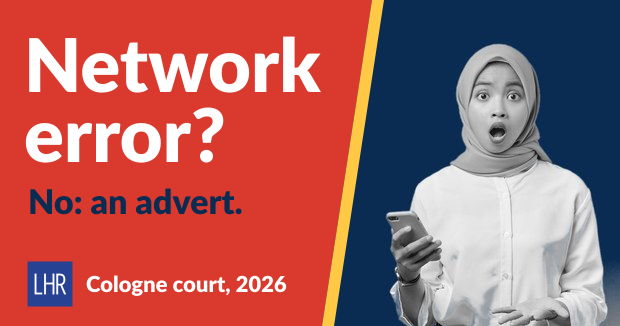 Where the name of the mobile network normally appears, many smartphones in Germany suddenly displayed “Im besten Netz” (“On the best network”) in January 2026.
The Regional Court of Cologne has classified this Telekom campaign as unreasonable harassment.
The ruling concerns not only network operators but every company that controls display areas on its customers’ devices.
In a judgment of 17 September 2026 (case no. 33 O 55/26), the Regional Court of Cologne (Landgericht Köln) held that Deutsche Telekom was not entitled to use the network name on its mobile customers’ smartphones as advertising space. The action was brought by the Federation of German Consumer Organisations (Verbraucherzentrale Bundesverband, vzbv), which published the judgment in October 2026. Telekom has appealed to the Higher Regional Court of Cologne (Oberlandesgericht Köln, case no. 6 U 103/26). The judgment is therefore not final.
The key points:
- The network name is a functional display. Anyone who replaces it with an advertising slogan takes over a space that customers do not expect to be used for advertising.
- Customers could neither switch the display off nor object in advance. In the court’s view, the attention forced on users was precisely part of the advertising concept.
- The court saw a risk that other providers would copy the method and prohibited the advertising as unreasonable harassment under Section 7(1) of the German Act against Unfair Competition (Gesetz gegen den unlauteren Wettbewerb, UWG).
Overview
- What did Telekom do?
- Why is this unreasonable harassment?
- Does it matter that the customers had a contract with Telekom?
- What are the parallels to inbox advertising?
- Who else is affected besides network operators?
- What does this mean for companies?
- Frequently asked questions about advertising in the network name
- Further information
What did Telekom do?
In January 2026, Telekom replaced the network name “Telekom.de” on numerous customer smartphones with the slogan “Im besten Netz”. The network name normally shows which mobile network the device is logged into. Depending on the device, it appears on the lock screen or in the control centre, places users look at many times a day.
According to the vzbv, customers could neither deactivate the changed display nor object to the change beforehand. The advertising had been “forced on them against their will”, the association said. According to media reports, Telekom ended the campaign early in February 2026. The vzbv nevertheless pursued its injunction claim, because ending a campaign does not remove the risk of repetition.
Why is this unreasonable harassment?
Because the advertising occupies a functional display and users cannot escape it. Under Section 7(1), first sentence, UWG, a commercial practice that unreasonably harasses a market participant is unlawful. Under the second sentence, this applies in particular to advertising where it is apparent that the recipient does not want it.
According to the reports published so far, the court relied mainly on three circumstances. Customers could initially take the slogan for a malfunction: anyone who sees an unfamiliar text instead of the usual network name is more likely to suspect a problem with the connection or the device than an advert. Only at second glance did it become clear that this was an advertising slogan. In the chamber’s view, this irritation was not a side effect but an essential part of the measure: Telekom had deliberately exploited the disruptive effect to generate attention. And customers had no way of removing the display.
A further aspect that courts regularly consider under Section 7 UWG is the risk of imitation. By simply changing the network name, network operators can reach millions of devices at once. If this were permitted, other providers could use the same space, and the harassment would multiply.
Does it matter that the customers had a contract with Telekom?
No, at least not in the result. An existing contract does not permit every form of advertising towards the customer. Existing customers, too, do not have to accept advertising everywhere. Section 7(3) UWG illustrates this: even email advertising to existing customers is only permitted under narrow conditions and with a right to object.
What matters is where the advertising appears. The mobile contract entitles the provider to supply the network and to display its name as network operator. It does not turn the customer’s smartphone into a billboard. The device belongs to the customer, and the status displays serve to inform the customer, not to market the provider.
What are the parallels to inbox advertising?
The ruling is in line with the case law on so-called inbox advertising. That case law concerned adverts placed in email inboxes in such a way that they looked like emails. The Court of Justice of the European Union (case C-102/20) and, subsequently, the German Federal Court of Justice (Bundesgerichtshof, BGH) required users to give express consent to such advertising. We reported on this in our article BGH ruling: inbox advertising in freemail requires express consent and information (in German).
The common idea: advertising must not push its way into areas that users perceive as their own functional or communication spaces, and certainly not in a way that initially makes it look like genuine information. The network name is a particularly clear case, because there is not even an advertising space nearby that the user would expect.
Who else is affected besides network operators?
Any company that can display content on its customers’ devices that the customer has not triggered. The judgment concerns a network name, but the underlying reasoning can be transferred:
- Device manufacturers of smartphones, tablets, smart TVs or wearables that show advertising on lock screens, in system notifications, on home screens or in pre-installed system apps,
- App providers that use push notifications or widgets for advertising without the user being able to unsubscribe,
- Providers of connected products (such as vehicles, household appliances, routers) whose displays or status messages are used for their own advertising,
- Platforms and online retailers that disguise advertising as status or system messages (“Your parcel”, “Security notice”).
This expressly also applies to foreign manufacturers that sell their devices in Germany. The UWG applies to the market in which the advertising has its effect. If the advertising appears on the devices of users in Germany, a German association or competitor can take action against it.
Besides Section 7 UWG, there is a second risk. If advertising is designed so that its commercial purpose is not immediately recognisable, a breach of the requirement to identify commercial communications may also be considered (Section 5a(4) UWG). According to the reports, the Telekom case was only about harassment. Where an advertising text is disguised as a system notice, however, misleading consumers about its advertising nature is an obvious issue.
What does this mean for companies?
Anyone who wants to reach customers via their own devices should have the campaign legally reviewed before launch. The following recommendations can be derived from the judgment:
- Functional displays are off limits. Network name, status bar, battery, update or security notices serve to inform users. Advertising texts have no place there.
- Opt-out from the start. Advertising on devices should only appear with consent or, at the very least, be easy to switch off permanently. An option added only after complaints does not help.
- Make advertising recognisable as advertising. Every display should be identifiable as advertising at first glance and should not look like an error message or system notice.
- Ending the campaign is not enough. Ending a campaign early does not remove the risk of repetition. Without a cease-and-desist declaration backed by a contractual penalty, the litigation risk remains.
- Respond quickly to warning letters. Under Section 8 UWG, consumer associations and competitors can demand injunctive relief, and competitors can also apply for a preliminary injunction. Deadlines are short, but a declaration signed too hastily is binding for good.
Conversely, competitors affected by such a campaign should act quickly: for a preliminary injunction, German courts generally require the application to be filed within about one month of becoming aware of the infringement.
Frequently asked questions about advertising in the network name
What did the Regional Court of Cologne decide?+
Is the judgment final?+
May a provider send advertising to its existing customers’ smartphones at all?+
Does this also apply to device manufacturers and app providers?+
Who can take action against such advertising?+
Are you planning advertising on your customers’ devices in Germany, or have you received a warning letter?
We review your campaign before launch or defend you against warning letters and preliminary injunctions. You will usually receive an initial assessment within 24 hours.
Further information
- BGH ruling: inbox advertising in freemail requires express consent (in German)
- LHR case: Regional Court of Cologne stops abandoned-cart emails by preliminary injunction (in German)
- Higher Regional Court of Hamm: social media messages are electronic mail (in German)
- Unsolicited telephone advertising: what is allowed and what is not? (in German)
- Our fields of activity
- Our successes
Related posts


Multiple awards.