LHR case study: GPSR and PPWR for small online shops – what souvenir shops and tourism associations need to know now
Your contact person

 Fridge magnet, town mug, accommodation guide in an envelope: for the small online shops of municipalities and tourism associations, the GPSR and the PPWR have suddenly become an issue, although nothing about the range has changed.
One regional tourism association has therefore stopped sending brochures abroad as a precaution. Is that really necessary?
The enquiry that reached us recently will sound familiar to many tourist information offices. A regional tourism association, whose members include every municipality in several districts as well as hotels and leisure facilities, wanted to know what the EU General Product Safety Regulation (GPSR) and the EU Packaging and Packaging Waste Regulation (PPWR) mean for its members. Most of them run a small online shop selling souvenirs and send out tourist brochures on request, in modest quantities. The association had already stopped sending brochures abroad as a precaution.
That caution is understandable, but in our experience it starts in the wrong place. For most small shops, the greater risk lies not in the brochure but on the souvenir shelf and in the mandatory information on the product page.
Overview
- GPSR and PPWR for small online shops: what actually applies?
- Putting your town logo on a mug makes you the manufacturer
- What information must every online offer contain?
- Shipping boxes and brochure envelopes: what does the PPWR require?
- What small shops and associations should do now
- Frequently asked questions on GPSR and PPWR for small online shops
- Further information
GPSR and PPWR for small online shops: what actually applies?
Since 13 December 2024, the GPSR has governed what information an online offer must contain and who is responsible for the safety of a consumer product. The PPWR has applied since 12 August 2026 and determines who must register and pay for packaging, in every country to which a consignment is sent. For a small shop, three questions therefore matter: what is being sold, under whose name, and where is it being shipped?
Regulation (EU) 2023/988 covers all consumer products, including those given away free of charge (Art. 3(1) GPSR). It is, however, only a safety net: where more specific legislation exists, that legislation takes precedence (Art. 2 GPSR). The soft toy is therefore governed primarily by toy safety law, the mug by the rules on food contact materials and the cotton bag by textile labelling law. The regional herbal liqueur, incidentally, falls under food law rather than the GPSR.
Putting your town logo on a mug makes you the manufacturer
Under the GPSR, a manufacturer is also anyone who has a product manufactured and markets it under its own name or trademark (Art. 3(8) GPSR). A municipality that orders a few hundred mugs bearing its town logo from a promotional goods supplier is therefore not a distributor but the manufacturer, with all the obligations under Art. 9 GPSR. In tourist shops this is the norm, and it is almost always overlooked.
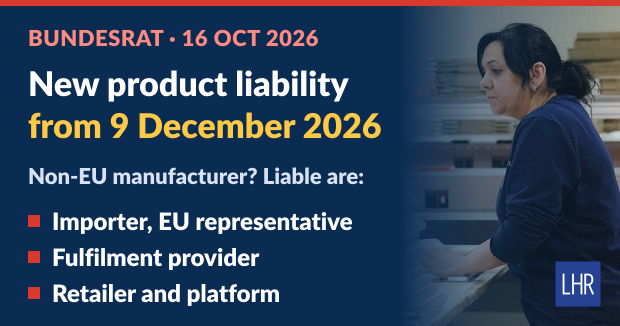
The supplier stays in the background; to the outside world, it is the municipality that appears. It must present itself as the manufacturer in the online offer, put its address on the product or its packaging and, if things go wrong, take responsibility for recalls and accident notifications. Anyone who presents themselves as the manufacturer by name or logo is also liable for damage under product liability law, which will not become any milder from 9 December 2026. We have explained separately what the new German Product Liability Act means for retailers and importers (in German).
The position is different for third-party branded goods resold unchanged. The shop then remains a distributor and, under Art. 12 GPSR, essentially has to check whether the manufacturer and importer details are present. Anyone who orders directly from a supplier outside the EU, on the other hand, becomes the importer (Art. 11 GPSR) and takes on its own verification and labelling obligations.
What information must every online offer contain?
Art. 19 GPSR requires every single offer to contain the following information clearly and visibly:
- the name, registered trade name or trademark of the manufacturer, with postal and electronic address,
- for manufacturers outside the EU, the responsible person in the Union,
- information identifying the product, including a picture and the product type,
- warnings and safety information in the language of the consumer, where required.
A reference to the legal notice (Impressum) is not enough. Missing information is now regularly the subject of warning letters, because Art. 19 GPSR is widely regarded as a rule governing market conduct within the meaning of Section 3a of the German Act against Unfair Competition (UWG). How strictly the courts treat missing mandatory notices is already apparent from case law on the old packaging rules, in which the Higher Regional Court of Cologne (Oberlandesgericht Köln) held that missing packaging law notices could be subject to warning letters (in German).
Shipping boxes and brochure envelopes: what does the PPWR require?
Anyone sending goods in a box or envelope to private customers in Germany needs, as before, a registration in the German packaging register LUCID and participation in a dual system. Since 12 August 2026, Regulation (EU) 2025/40 has applied directly, supplemented by the German Packaging Law Implementation Act (VerpackDG), which replaced the Packaging Act. Anyone who has failed to register so far did not, of course, acquire the problem in August; it already existed under the old law, which we summarised for online retailers back in 2017 (in German).
Payment is irrelevant here, because the PPWR also covers packaging made available free of charge. The envelope containing the free accommodation guide is therefore just as much shipping packaging as the box containing the mug that was sold.
Shipping abroad is where things genuinely become laborious. Under the PPWR, the producer is whoever first makes packaging available in a Member State (Art. 3(15) PPWR). Anyone who delivers directly to private individuals in Austria or the Netherlands becomes the producer there, must register in the local register and, having no establishment there, appoint an authorised representative (Art. 44 et seq. PPWR). There is no EU-wide registration, and for a handful of envelopes a year the effort is out of all proportion. The PPWR does not apply to deliveries outside the EU, for example to Switzerland or the United Kingdom; the respective national rules apply there.
What small shops and associations should do now
The tasks are manageable if tackled in the right order:
- Sort the range: for each item, clarify who made it, under whose name it is sold and whether specific legislation applies. This determines your own role as distributor, importer or manufacturer.
- Add the mandatory information: the details required by Art. 19 GPSR belong in every offer. If a supplier does not provide them, that is a reason to delist the item.
- Secure own-brand goods: anyone who is the manufacturer needs declarations of conformity and test reports from the supplier and should record this in the purchase agreement.
- Sort out domestic packaging: check the LUCID registration and system participation, counting the brochure envelopes as well.
- Reorganise shipping abroad: answer enquiries from abroad with the digital brochure, send brochures without an envelope, or find a joint solution via an authorised representative for one or two key countries.
A word on unpackaged shipping: an addressed brochure without an envelope is not a packaged product, although a band or film wrap turns it back into one.
For an association, this is an opportunity to take a great deal of work off its members, for example with template information for the shops, uniform requirements for suppliers and a joint solution for the few countries from which enquiries actually come. How quickly missing registrations can end up in court is shown by our recent case study on a missing battery registration before the Regional Court of Düsseldorf (in German); further proceedings can be found on our page Our successes.
Frequently asked questions on GPSR and PPWR for small online shops
Does the GPSR also apply to free brochures?+
Does a small shop have to register its shipping boxes?+
Who is the manufacturer of mugs bearing the town’s own logo?+
Can brochures still be sent to Austria or the Netherlands?+
Can missing GPSR information lead to a warning letter?+
Do you run a souvenir shop or send brochures abroad?
Send us the link to your shop and the countries you ship to. We will tell you which offers need to be improved and how to organise shipping abroad without a registration marathon; for associations and networks, we also offer the topic as a talk on site or online. You will usually receive an initial assessment within 24 hours.
Further information
- Product safety & GPSR (in German)
- Labelling & compliance (in German)
- Our fields of activity
- Our successes
Related posts




Multiple awards.