LHR case study: Cross-border copyright warning letter against a Dutch company – why international cases are often underestimated
Your contact person

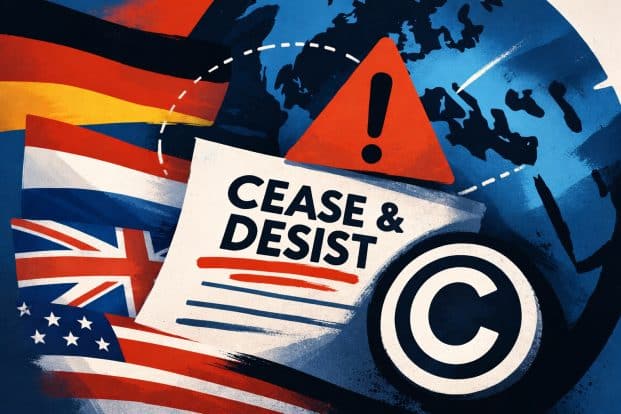 A European company operates an internationally accessible website. A single photograph is used in an editorial blog post. The image is later removed. Months afterwards, a German copyright warning letter arrives – with a short deadline, a substantial monetary claim, and a proposed cease-and-desist declaration.
This pattern is common: the real pressure is not only the damages demand, but the long-term exposure created by a cease-and-desist undertaking. In cross-border cases, an additional layer arises: uncertainty regarding jurisdiction, enforcement, and the actual litigation risk.
The background
A German photographer instructed counsel to issue a formal warning letter concerning the online use of one of his works on a corporate website. The photo was made available online as part of an editorial article. The claims typically rely on public communication/making available to the public (§ 19a German Copyright Act), the right of attribution (§ 13), and injunctive relief and damages (§ 97).
Damages were asserted based on a license analogy approach, supplemented by surcharges (in particular for alleged missing attribution) and interest. In addition, reimbursement of legal fees was demanded. The warning letter was accompanied by a request to sign a cease-and-desist declaration including a significant contractual penalty per breach.
Jurisdiction and applicable law – German proceedings despite a foreign seat?
Foreign companies often underestimate how readily German courts assume jurisdiction in online cases. In practice, mere accessibility in Germany combined with commercial relevance for the German market can make litigation in Germany a realistic scenario.
Within the EU, enforceability across borders must also be considered. This increases pressure – not because every claim is necessarily justified, but because deadlines, cost risk and enforcement mechanics can shift negotiation leverage.
The core risk: the cease-and-desist declaration
In many matters, the largest exposure is not the one-off payment, but the cease-and-desist declaration. Once signed, it forms an independent contract. Any future breach – even negligent – may trigger the contractual penalty. Companies with multiple teams, agencies or CMS processes are particularly exposed to inadvertent repeat issues.
Accordingly, pre-drafted undertakings should never be signed without review and modification. Common adjustment points include limiting the scope to the concrete infringement, precisely identifying the protected work, and implementing a more reasonable penalty mechanism (often a flexible, court-proof approach instead of a fixed lump sum).
License analogy, surcharges and market reality
A license analogy is not a blank cheque. The benchmark is what reasonable parties would realistically have agreed in a hypothetical licensing negotiation. Relevant factors include the duration and reach of the use, the context (editorial vs. advertising), the photographer’s actual licensing practice, and comparable market rates.
While German case law may accept surcharges for missing attribution in principle, the amount is not automatic. Especially in cross-border settings, the exact attribution setup (where, how, visibility) must be reconstructed carefully.
Prior direct contact – often an overlooked lever
In many cases, the rights holder contacted the company directly before involving counsel. This can matter when assessing whether legal fees were necessary in the first place. Such details are frequently overlooked in the initial reaction to a high claim and a short deadline – yet they can materially improve settlement dynamics.
Conclusion
Cross-border copyright warnings are not merely “payment issues”. They are strategic matters. Companies that pay or sign too quickly often assume unnecessary long-term exposure. The right sequence is: assess liability, benchmark the claim, carefully tailor the cease-and-desist declaration, realistically evaluate jurisdiction and enforcement risk – and only then negotiate.
Multiple awards.