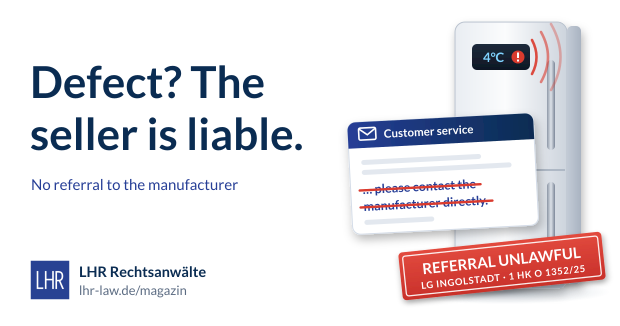

A customer bought a fridge-freezer for EUR 899.99 via mediamarkt.de on 4 February 2024. Around 16 months later, he reported a defect by e-mail: the appliance’s alarm sounded even with the door closed and could not be switched off. The customer service reply of 30 June 2025 contained the sentence: “To assert your guarantee/warranty claims, please contact the manufacturer directly.” A further e-mail of 8 July 2025 again referred him to the manufacturer for a “repair subject to a charge”, because the guarantee had expired.
The buyer was an employee of the Federation of German Consumer Organisations (Verbraucherzentrale Bundesverband, vzbv) and had made the purchase privately. On 15 July 2025, the vzbv sent a cease-and-desist letter to MMS E-Commerce GmbH, which operates the online shop. No cease-and-desist declaration was given. By final judgment of 24 July 2026, the Regional Court of Ingolstadt (Landgericht Ingolstadt) granted the action in full (LG Ingolstadt, judgment of 24 July 2026, case no. 1 HK O 1352/25). The vzbv published the decision on 8 October 2026. The publication does not state whether the judgment is final. An appeal to the Higher Regional Court of Munich (Oberlandesgericht München) is admissible.
The key points of the judgment:
- Misleading statement about consumer rights: referring the customer to the manufacturer creates the impression that the seller is not responsible for defects. This infringes Section 5(1) and (2) no. 7 of the German Act against Unfair Competition (UWG).
- A single case is enough: systematic conduct is not required. The court relies on the case law of the Court of Justice of the European Union (CJEU).
- The customer’s prior knowledge is irrelevant: the fact that the recipient was a lawyer at the vzbv and was not deterred makes no difference.
- Consequences: an injunction backed by an administrative fine of up to EUR 250,000 for each infringement, a flat-rate fee of EUR 350 for the cease-and-desist letter, and an amount in dispute of EUR 15,000.
What exactly did the Regional Court of Ingolstadt prohibit?
The defendant may no longer tell consumers, or have them told, who assert warranty claims because of a defect in a product bought via mediamarkt.de, that they should contact the manufacturer directly. The prohibition refers to the specific form of infringement, i.e. the e-mail correspondence in the proceedings. Under the German “core theory” (Kerntheorie), however, it also covers wording that is essentially the same. Anyone who merely rephrases the sentence therefore remains within the scope of the prohibition.
The 1st Chamber for Commercial Matters limited the prohibition to statutory warranty claims (Gewährleistung). A mere reference to a voluntary manufacturer’s guarantee remains permissible. The vzbv had only used the wording “guarantee/warranty claims” because the defendant itself had used it. The court did not regard this as a partial defeat for the association. The defendant has to bear the costs of the proceedings and reimburse the flat-rate fee under Section 5 of the German Injunctions Act (UKlaG) and Section 13(3) UWG.
Why is a referral to the manufacturer misleading?
Because it misrepresents the legal position. Under Section 437 of the German Civil Code (Bürgerliches Gesetzbuch, BGB), the seller, as the contracting party, is liable for defects. The buyer can demand subsequent performance from the seller under Section 439 BGB, i.e. repair or replacement, and, subject to further conditions, withdraw from the contract, reduce the price or claim damages. The manufacturer is not the buyer’s contracting party. It is only liable to the buyer if it has voluntarily given a guarantee under Section 443 BGB. The guarantee exists alongside the statutory rights; it does not replace them.
Section 5(2) no. 7 UWG expressly lists the rights of the consumer, “in particular those based on guarantee promises or warranty rights in the event of irregularities in performance”, as a possible subject of misleading statements. The court read the sentence in the e-mail in the context of the preceding complaint. An average, reasonably well-informed consumer would understand it to mean that the seller has no obligation of its own, neither under a guarantee nor under the statutory warranty. The chamber found nothing in the wording to indicate that the seller acknowledged its liability and merely wanted to organise the handling via the manufacturer. The regret expressed about the defect was not sufficient either. The seller’s own responsibility was only addressed in a later e-mail of 3 July 2025.
The decisive point is the distinction from a mere legal opinion. A business may put forward its legal view in a dispute about claims, even if that view later turns out to be wrong. This only applies, however, if the customer can recognise that it is an opinion. The customer service e-mail contained no such reservation. It presented the legal position as settled and was therefore a statement capable of deceiving.
The fact that the communication only took place after the purchase does not help. Conduct after the conclusion of a contract is also a commercial practice within the meaning of Section 2(1) no. 2 UWG if it is objectively connected with the performance of the contract. The e-mail was capable of influencing against whom the customer asserts his rights. That is sufficient.
Is a single e-mail really enough?
Yes. In the chamber’s view, a misleading statement aimed at fending off claims requires neither systematic conduct nor subjective elements, a certain frequency or a minimum number of affected customers. The court refers to the CJEU judgment of 16 April 2015 (C-388/13, UPC Magyarország). According to that judgment, even a single item of incorrect information given to a single consumer can be an unfair commercial practice.
The defendant had spoken of an “obviously atypical individual course of events” and of a mistake by a customer service employee. It did not succeed with this argument. The infringement already committed is sufficient to establish a risk of repetition. In any event, under Section 8(2) UWG a business is liable for errors of its employees as for its own conduct.
It is also irrelevant that the customer was not put off and continued to pursue his claims against the seller. What matters is whether the statement is capable of deterring consumers from asserting their rights against the correct party.
Does it matter that the customer was a lawyer?
No. The defendant had argued that the recipient was a vzbv employee experienced in consumer law who knew the difference between statutory warranty and guarantee. The chamber left open whether a standard other than that of the average consumer may apply in individual communication. At most, that could be considered if the customer service employee was able to recognise the special prior knowledge. The defendant had not put forward anything specific on this, and the customer’s complaint gave no indication of it.
In practice, this means that anyone sending standard replies has to tailor them to the average consumer. No one can rely on the recipient’s training.
Which obligations have applied to complaints since 31 July 2026?
German sales law was amended again this summer by the Act implementing Directive (EU) 2024/1799 on promoting the repair of goods of 16 July 2026 (Federal Law Gazette (BGBl.) 2026 I No. 212). Under Art. 229 Section 72 of the Introductory Act to the Civil Code (EGBGB), the new law applies to sales contracts concluded on or after 31 July 2026. Three points are important for customer service in consumer sales:
- Duty to inform before subsequent performance: under the new Section 475(4) BGB, the business must inform the consumer before carrying out subsequent performance. It must explain the consumer’s right to choose between repair and replacement and that the limitation period is extended once by twelve months in the case of repair.
- Twelve more months after repair: if subsequent performance takes the form of repair, the original limitation period for claims for defects is extended once by twelve months under Section 475e(5) BGB.
- Reasonable period: under Section 475(6) BGB, subsequent performance must be carried out within a reasonable period from the notification of the defect and without significant inconvenience to the consumer.
A further new element is the manufacturer’s obligation to repair under Sections 479a et seq. BGB. It concerns certain product groups listed in Annex II of the Directive, such as refrigerators, washing machines, dishwashers or smartphones, and only applies once the consumer no longer has any rights for defects against the seller. If the manufacturer is established outside the EU, Section 479f BGB places these obligations on its authorised representative in the EU, failing that on the importer and finally on the distributor. The route to the manufacturer therefore supplements the statutory warranty; it does not replace it.
A standard reply saying “Please contact the manufacturer” is therefore doubly problematic under the new law. It misrepresents liability and omits the information that is now mandatory. Whether courts will also treat a breach of Section 475(4) BGB as a breach of statutory duty under Section 3a UWG or as withholding material information under Section 5a UWG has not yet been decided. Sellers should expect cease-and-desist letters.
What does the judgment mean for online retailers, marketplace sellers and manufacturers?
It affects everyone who sells to consumers, from large electronics retailers to small online shops. Businesses that have outsourced their customer service or work with pre-written text modules are particularly at risk. Our recommendations:
- Review your text modules: sentences such as “Please contact the manufacturer” or “The manufacturer is responsible for the warranty” should be deleted where statutory rights for defects are concerned.
- Offer the manufacturer’s service only as an extra: a reference to the manufacturer’s on-site service remains possible if it is clear that the seller remains liable. For example: “Your statutory warranty rights exist against us. If you wish, you can also use the manufacturer’s repair service. This is voluntary.”
- Keep guarantee and statutory warranty clearly apart: anyone referring to a manufacturer’s guarantee should make clear that it does not restrict the statutory rights. The CJEU has already ruled on information obligations regarding manufacturer’s guarantees (see our article “CJEU: online retailers must provide information about manufacturer’s guarantees”, in German).
- Add the new mandatory information: for contracts concluded on or after 31 July 2026, the reply to a complaint must point out the right to choose and the twelve-month extension in the case of repair before subsequent performance begins.
- Label your own legal position as such: anyone who believes that there is no defect, or that it only arose after delivery, may say so. Once the one-year presumption under Section 477 BGB has expired, it is generally for the buyer to prove that the defect already existed at the time of delivery. The reply should then be worded as the seller’s own assessment and must not deny the seller’s responsibility.
- Train employees and service providers: the business is liable for errors in customer service. Training and regular spot checks in the ticket system cost less than enforcement proceedings for administrative fines.
The same applies to marketplace sellers. On Amazon, eBay or Temu, the respective seller is generally the buyer’s contracting party and therefore owes the statutory warranty. This also concerns manufacturers and sellers from China and other non-EU countries who sell directly to German consumers. Under Art. 6(1) of the Rome II Regulation, unfair competition is generally governed by the law of the market in which consumers are targeted. A referral to the factory or the brand owner abroad is therefore just as risky as the referral to the manufacturer in the Ingolstadt case.
Anyone who has received a cease-and-desist letter should take the deadline seriously but should not sign the pre-formulated cease-and-desist declaration without checking it. It is often broader than necessary and may trigger a contractual penalty for every future error in customer service. An individually drafted declaration limited to the specific form of infringement is often the better option.
Frequently asked questions on warranty claims and referrals to the manufacturer
May a seller in Germany refer customers with a defect to the manufacturer?+
What is the difference between statutory warranty and guarantee?+
Is a single case enough for a cease-and-desist letter?+
What must a seller tell consumers about a complaint since 31 July 2026?+
Does this also apply to Chinese sellers who sell to Germany via Amazon?+
Have you received a German cease-and-desist letter about your customer communication, or do you want to make your service templates compliant?
We review cease-and-desist letters and declarations and revise your text modules for complaints in line with the legal position applicable since 31 July 2026. You will usually receive an initial assessment within 24 hours.
Further information
- CJEU: online retailers must provide information about manufacturer’s guarantees (in German)
- New German sales law since 1 January 2022 (in German)
- LHR case study: administrative fine despite Amazon’s automatic RRP display (in German)
- LHR case study: when Amazon makes life difficult for reputable sellers (in German)
- LHR fields of activity
- Our successes
Related posts