
Anyone who wanted their house blurred on Google Street View has had a comparatively easy time so far: Google offers pixelation on request. From above, things looked different. In Google Earth and in the 3D view of Google Maps, many homes can be seen as detailed models – with roof shape, windows, balconies, terraces and pools, including areas no passer-by can see into. Google refuses to blur these views on request.
In a judgment of 24 September 2026 (case no. 2-03 O 388/25), the Regional Court of Frankfurt am Main has put a stop to this. The claimant, a father from Frankfurt, had previously succeeded in having his house blurred on Google Street View and Apple Look Around. The court prohibited Google from disseminating 3D depictions of his property in Google Earth and Google Maps.
- The first known German judgment prohibiting Google from publishing aerial or 3D images of a residential property.
- Legal basis: Section 823(1) and Section 1004(1) of the German Civil Code (Bürgerliches Gesetzbuch, BGB), applied by analogy, in conjunction with the general right of personality, including the right to informational self-determination.
- The garden behind the house belongs to the protected domestic sphere of retreat, not to the social sphere.
- The owner does not have to prove a particular risk, for example of burglary.
- The judgment is not final; it is open whether Google will appeal.
What was the Frankfurt case about?
The question was whether an owner can demand that his inhabited property disappear from Google Earth and Google Maps or be blurred. The claimant lives with his family in a house in Frankfurt. On Street View and Apple Look Around, his house had already been blurred at his request. In Google Earth and in the 3D view of Google Maps, however, it remained visible as a three-dimensional model – including the rear parts of the property that cannot be seen from the street.
Google refused to blur the property in these services. The owner sued for an injunction and succeeded before the Regional Court of Frankfurt am Main. According to reports on the judgment, it is the first time that a German court has prohibited this practice.
One detail matters for what comes next: the operative part of the judgment concerns 3D depictions of the property in Google Earth and Google Maps, while the reasoning focuses mainly on aerial images and the parts of the property that cannot be seen from outside. How far the prohibition extends in an individual case therefore also depends on how a claim is worded.
Why does the court consider privacy to be infringed?
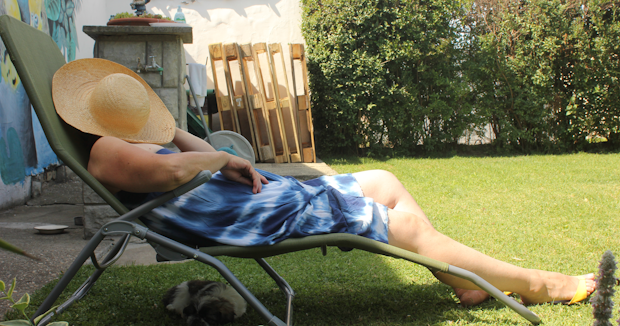
The court assigns the garden, the terrace and the other rear areas of an inhabited property to the private sphere. In the chamber’s view, the domestic sphere of retreat does not end at the wall of the house; it extends to the entire property. Anyone sitting in their own garden may rely on not being observed there.
The chamber states that nobody has to accept aerial images of their inhabited property being published worldwide without their consent – at least where they show areas that cannot be seen from outside.
Three aspects played a role for the court:
- Insight into the way of life: The images may allow conclusions about how the family lives – for example whether there is a pool, play equipment or a terrace, and how the property is used.
- Security: Property boundaries and access points become visible. Combined with other data, including with the help of AI, the house can be linked to its residents.
- Secrecy: The images are not announced. Those affected do not know when flights take place and cannot protect themselves in advance. The court speaks of “spying” (Ausspähung).
Protection does not depend on how wealthy the owner is. Nor does the owner have to show that he is at particular risk of burglary.
Why do Google’s arguments fail?
Google relied on freedom of information and the purpose of its services. The court expressly recognises the aim of letting users explore the world digitally as legitimate. Weighed against the intrusion into the private sphere of retreat, however, it does not consider that aim worthy of protection. Neither the users’ “spirit of adventure” nor the “democratisation of knowledge” justify making a family’s garden visible worldwide.
The balancing of interests was decisive, and one factor weighed heavily: Google has a less intrusive means at its disposal – pixelation. Google has offered exactly that for Street View for years. The court was not persuaded that this should be impossible for aerial images and 3D models.
How does this fit with the Itzehoe judgment of 2020?
The Frankfurt judgment stands in clear contrast to an earlier decision. On 11 June 2020, the Regional Court of Itzehoe (Landgericht Itzehoe, case no. 10 O 84/20) dismissed a comparable claim. It focused mainly on property law: under Section 905 sentence 2 BGB, an owner cannot prohibit overflights at the altitude from which such images are taken. The court also considered the information visible in the images too unspecific to infringe the right of personality. We reported on that decision (in German): LG Itzehoe: Kein Recht auf Verpixelung eines Grundstücks in Google Earth.
The Regional Court of Frankfurt am Main takes a different approach. It does not ask whether the overflight itself can be prohibited, but whether worldwide publication of the images infringes the general right of personality (Article 2(1) in conjunction with Article 1(1) of the German Basic Law). For the injunction, it relies on Section 823(1) BGB and Section 1004(1) BGB by analogy. Technology has changed since 2020: flat satellite images have become detailed 3D models that can be combined with other data. The Frankfurt judgment takes this change into account.
There is no ruling yet from a higher regional court or the Federal Court of Justice (Bundesgerichtshof, BGH). Until then, two lines of first-instance case law stand side by side.
Who can rely on the judgment?
The judgment directly binds only the parties to the Frankfurt proceedings. Its reasoning can, however, be applied to many cases in which an inhabited property with areas not visible from outside can be seen in Google Earth or Google Maps. The position is strongest where
- the property is lived in by the claimant (family, children, garden as a place of retreat),
- the images show areas that are not visible from the street,
- Google was expressly asked beforehand to blur the property and refused.
It remains open how courts will assess cases involving tenants, holiday homes or commercial properties. The judgment is based on the protection of private life. For purely commercial premises the balancing may therefore turn out differently; for persons with particular security needs it is likely to be even more favourable.
What does this mean for owners and residents?
If you do not want your property to be viewable from the air worldwide, you now have a court decision you can rely on. A structured approach makes sense:
- Check: Look at your property in Google Earth and in the satellite and 3D views of Google Maps. Which areas are visible that are hidden from the street?
- Document: Save screenshots with the date and the address or coordinates. Record exactly what can be seen (garden, terrace, pool, access points).
- Request: Ask Google in writing, setting a deadline, to blur the property in Google Earth and Google Maps. Refer to the judgment of the Regional Court of Frankfurt am Main of 24 September 2026 (case no. 2-03 O 388/25). Keep the reply.
- Enforce: If Google refuses or does not respond, a cease-and-desist letter and legal action are options. Interim relief under Sections 935 and 940 of the German Code of Civil Procedure (ZPO) requires urgency. Those who wait too long after becoming aware of the issue lose this option. Many German courts consider urgency rebutted after about one month.
- Keep in mind: The judgment is not final. An appeal to the Higher Regional Court of Frankfurt am Main (Oberlandesgericht Frankfurt am Main) is possible. Anyone taking action now should be aware of the cost risk.
Data protection claims may also be considered, for example an objection under Art. 21 GDPR or a request for erasure under Art. 17 GDPR, to the extent that the property can be linked to a person. The Frankfurt court based its decision on the right of personality; both routes can be combined in one letter.
What does this mean for Google and other map services?
If the next instance upholds the judgment, Google will need a procedure for aerial images and 3D views like the one that has existed for Street View for years: a request to blur that is reviewed and implemented. The court’s reasoning does not concern Google alone. It can be applied to any provider that makes high-resolution aerial images or 3D models of inhabited properties publicly available.
In practice, a pattern emerges that we know from other proceedings against Google: Google refuses out of court, and the courts take a different view. This applies to false statements by Google’s AI (in German) as well as to unlawful reviews. A well-documented request with a clear deadline is therefore often the decisive first step.
Frequently asked questions about Google Earth and aerial images of residential properties
Can I demand that Google blur my house in Google Earth?+
Do I have to prove that my house is at particular risk?+
Does the judgment also apply to Google Maps?+
Can I also object to drone or aircraft overflights?+
How quickly do I have to act?+
Can your property be seen in Google Earth or Google Maps?
We assess whether you can demand that it be blurred and enforce your claim against Google – out of court and, if necessary, in court. You will usually receive an initial assessment within 24 hours.
Further information
- LG Itzehoe: No right to have a property blurred in Google Earth (in German)
- Who is responsible for pixelating photos? (in German)
- LG Frankfurt: Freedom of panorama applies to aerial drone images (in German)
- LG Aachen: Google is liable for false statements by its AI (in German)
- Our fields of activity
- Our successes
Related posts