
The German Product Liability Act (Produkthaftungsgesetz, ProdHaftG) dates from 1989. It was written for a world in which goods reached shops through importers and wholesalers. Today, consumers order directly from manufacturers in Shenzhen or Ningbo, the goods sit in a warehouse in North Rhine-Westphalia and are sold through a marketplace or the manufacturer’s own online shop. Who is liable when a battery catches fire or a fan heater causes an electric shock was often hard to answer in such set-ups.
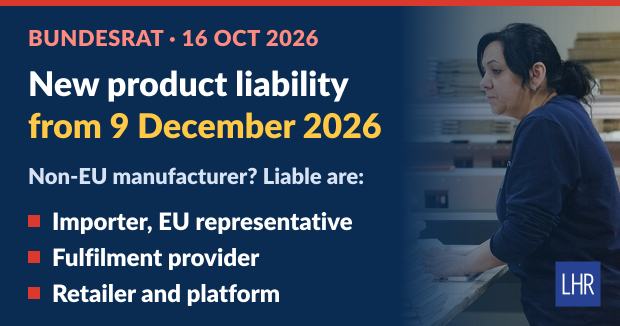
That is now changing. On 8 October 2026, the German Federal Parliament (Bundestag) passed the “Act to Modernise Product Liability Law and to Amend Further Provisions” (Government Bill, Bundestag printed paper 21/4297, as amended by the committee recommendation 21/8429). On 16 October 2026, the Bundesrat decided not to refer the act to the mediation committee (Bundesrat printed paper 584/26 (B)). The act implements the EU Product Liability Directive (EU) 2024/2853 and is due to enter into force on 9 December 2026. Signature and promulgation in the Federal Law Gazette are still pending.
The key points at a glance:
- If the manufacturer is established outside the EU, the importer and the EU authorised representative are liable as if they were the manufacturer.
- If there is neither, the fulfilment service provider is liable, followed by the distributor and, in certain cases, the online platform.
- Software, digital manufacturing files and related digital services are covered.
- Courts can order the disclosure of evidence. If a product breaches product safety rules, a defect is presumed.
- The deductible for property damage and the liability cap for personal injury are abolished.
- The new rules apply to products placed on the market or put into service from 9 December 2026.
What has the legislature adopted?
The legislature replaces the 1989 Product Liability Act with an entirely new act. It implements Directive (EU) 2024/2853 of 23 October 2024 on liability for defective products, which replaces the old Directive 85/374/EEC. Member States must transpose it by 9 December 2026.
At its core, liability remains strict: whoever places a defective product on the market is liable for personal injury and for damage to property used for private purposes, irrespective of fault. What is new is above all who must answer alongside the manufacturer, what counts as a product and how injured parties can prove a defect.
The Bundestag passed the act with the votes of CDU/CSU, SPD and Bündnis 90/Die Grünen (Bundestag report, in German). In an accompanying resolution, it asks the Federal Government to examine whether authorised representatives of manufacturers from third countries should have to prove liability insurance or a comparable form of security, and what requirements should apply to their reachability, reliability and expertise. No such obligation has been adopted yet.
Who is liable if the manufacturer is based outside the EU?
A chain of operators within the EU is liable, step by step. The explanatory memorandum states the reason openly: injured parties are increasingly dealing with products whose manufacturers are established outside the European Union.
The order under the new act:
- Manufacturer (Section 3): anyone who develops or manufactures a product, or has it developed or manufactured. Anyone who presents themselves as the manufacturer by putting their name, trade mark or other distinguishing feature on the product is also treated as the manufacturer. This affects retailers selling goods from China under their own brand.
- Importer and authorised representative (Section 10): if the manufacturer is established outside the EU, the importer and the authorised representative in the EU appointed in writing by the manufacturer are liable as if they were the manufacturer.
- Fulfilment service provider (Section 11): if there is neither an importer nor an authorised representative in the EU, the fulfilment service provider is liable as if it were the manufacturer. A fulfilment service provider is anyone who, in the course of business, offers at least two of the following services for products it does not own: warehousing, packaging, addressing and dispatch. Postal and freight services are excluded.
- Distributor (Section 12): if none of these operators in the EU can be identified, any distributor is liable as if it were the manufacturer, unless it names a liable operator ranking ahead of it or its own supplier within one month of being asked by the injured party.
- Online platform (Section 13): for providers of marketplaces that allow consumers to conclude distance contracts with traders, distributor liability applies accordingly if the conditions of Art. 6(3) of the Digital Services Act (DSA) are met. In simple terms: if the platform gives the average consumer the impression that it is offering the product itself.
The importer was already liable under the old law (Section 4(2) ProdHaftG). The authorised representative, the fulfilment service provider and the platform are new. Several liable parties are jointly and severally liable (Section 15). The injured party can therefore choose whom to sue; recourse is settled between the liable parties. Liability towards the injured party cannot be excluded or limited by contract (Section 18).
What does this mean for Chinese manufacturers selling directly to German customers?
The Chinese manufacturer remains liable itself; it is simply harder for injured parties to reach. What is new is that its partners in Europe now share the risk and will therefore pass it back to the manufacturer by contract.
The typical model of “goods from China, warehouse in Germany, sale via a marketplace” has so far been difficult for injured parties to tackle. Often there was no importer in the legal sense, because the manufacturer itself acted as the seller. In future, the exposed party will be the EU authorised representative, which the General Product Safety Regulation (EU) 2023/988 (GPSR) already requires under Art. 4 for placing products on the market, and, where there is none, the fulfilment warehouse.
In practice, European partners will demand contract terms that protect them against this liability risk. Expect indemnity clauses, proof of product liability insurance covering the EU, security deposits and audit rights. Authorised representatives and fulfilment providers that have so far worked for low flat fees will reconsider their prices or turn clients away. Manufacturers that can show good documentation, robust conformity evidence and insurance will find partners more easily.
For German retailers that have goods manufactured in China under their own brand, nothing changes: they are manufacturers themselves and fully liable.
Is software now a product too?
Yes. Software will be a product regardless of how it is supplied, whether installed on the device, downloaded or used over a network (Section 2). This includes AI systems. The only exception is free and open-source software developed or supplied outside the course of a commercial activity. Digital manufacturing files, such as files for 3D printing, are also products.
For manufacturers of connected devices such as robot vacuum cleaners, security cameras, e-bikes with apps or chargers with firmware, two points matter. Related services without which the product could not perform one of its functions count as a component (Section 4). If the manufacturer retains control over the product through software updates or such services, the relevant time for assessing a defect is not only the time of sale, but the time the product leaves its control (Section 8). If a security update is missing, the manufacturer cannot argue that the defect did not exist when the product was placed on the market (Section 9(2)).
When assessing whether a product is defective, cybersecurity requirements, recalls and a product’s ability to continue learning after being placed on the market are expressly taken into account (Section 7).
How easily can injured parties prove a defect in future?
Much more easily than before. If the claimant presents facts and evidence that make the claim plausible, the court will, on application, order the defendant to disclose relevant evidence (Section 19). Disclosure is limited to what is necessary and proportionate. Trade secrets are protected and can be classified as confidential, but they do not block disclosure.
Statutory presumptions build on this (Section 20). A defect is presumed if
- the defendant fails to disclose evidence despite a court order,
- the product does not comply with mandatory product safety requirements intended to protect against the risk that materialised, or
- the damage was caused by an obvious malfunction during foreseeable use.
If the defect is established and the damage is typically consistent with such a defect, the causal link is also presumed. For technically or scientifically particularly complex products, it may be sufficient for the claimant to show that the defect and causation are likely.
For manufacturers from third countries, the second presumption is the most important: product compliance becomes a liability issue. If an electrical device lacks a mandatory safety test or a toy does not meet the limit values, this may be enough to presume a defect in the event of damage, provided that the rule breached is intended to protect against the very risk that materialised.
Which types of damage will be compensated?
More than before. Compensation covers death and personal injury, expressly including medically recognised damage to psychological health, damage to other property not used exclusively for professional purposes and, for the first time, the destruction or corruption of data not used for professional purposes (Section 1). Damage to the defective product itself remains excluded; warranty law applies to that.
Two limits of the old law disappear: the injured party’s deductible of EUR 500 for property damage (Section 11 ProdHaftG) and the liability cap of EUR 85 million for personal injury (Section 10 ProdHaftG).
The limitation period remains three years from knowledge (Section 16). Claims generally expire ten years after the product was placed on the market. For personal injuries that only become apparent after a long latency period, the period is extended to 25 years (Section 17). If a product is substantially modified, the period starts again when it is made available anew.
When do the new rules apply, and to which products?
The new act is due to enter into force on 9 December 2026. For products placed on the market or put into service up to and including 8 December 2026, the old Product Liability Act continues to apply (Section 23).
What matters is the individual product, not the product line. A model that has been sold for years may therefore fall under the old or the new rules depending on the individual unit. For stock, it is worth documenting verifiably when it was placed on the market.
What does this mean for manufacturers, importers and fulfilment service providers?
Time until 9 December 2026 is short. We recommend the following steps:
- Clarify the EU responsible person: determine for each product who the importer or authorised representative is, and keep the written mandate on file. If there is neither, the risk lands with the fulfilment warehouse and the distributor. They will not accept this for long.
- Check insurance: does the product liability insurance cover damage in the EU, software and data damage, and claims against the importer, authorised representative and fulfilment partner?
- Adjust contracts: indemnity and recourse between the parties (Section 15), cooperation in court disclosure orders, access to technical documentation, recall costs.
- Document compliance: declarations of conformity, test reports, GPSR risk analysis, labelling with details of the manufacturer and the EU responsible person. These documents will be requested in litigation and decide whether a defect is presumed.
- Organise updates: for connected products, define for how long and through which channel security updates will be provided.
- Mind private labels: anyone selling goods under their own name or brand is liable as a manufacturer, even if production takes place in China.
- Check before signing: fulfilment service providers should require clients from third countries to prove that an importer or authorised representative exists in the EU. If there is none, they are liable themselves as if they were the manufacturer.
Product liability, product safety and market surveillance will be even more closely intertwined. Taking obligations under the GPSR, the German Electrical and Electronic Equipment Act (Elektro- und Elektronikgerätegesetz, ElektroG) or battery law seriously also reduces liability risk.
Frequently asked questions about Germany’s new Product Liability Act
Does the new Product Liability Act also apply to products already sold?+
Is a fulfilment service provider liable for products of Chinese manufacturers?+
Can a manufacturer exclude product liability by contract?+
Does the EU authorised representative need liability insurance?+
What happens if a distributor cannot name the manufacturer?+
Do you sell products of a non-EU manufacturer in Germany?
We review your supply chain, your contracts with importers, authorised representatives and fulfilment partners, and your product compliance in light of the new liability rules. You will usually receive an initial assessment within 24 hours.
Further information
- Neues Produkthaftungsgesetz: Wer haftet ab Dezember, wenn der Hersteller in China sitzt? (in German)
- EUR 2 per item from 1 November: the new EU handling fee for online retailers (in German)
- LHR case study: product safety and Amazon listings (in German)
- How the ElektroG affects Amazon sellers: WEEE numbers and listing blocks (in German)
- Our fields of activity
- Our successes
Related posts