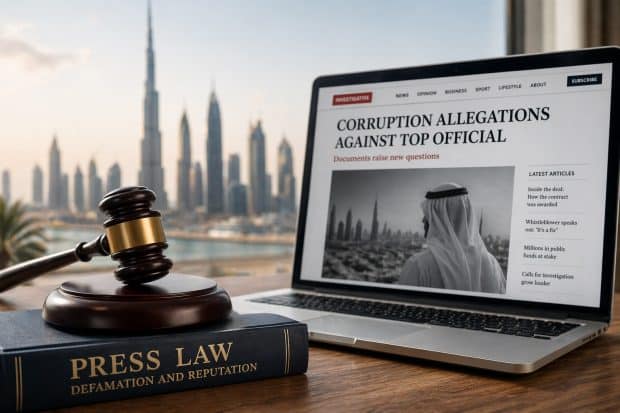
What has become increasingly clear in our practice is no coincidence, but a consistent trend: more and more clients from abroad are turning to LHR to take action against false or unlawfully exaggerated reporting originating from Germany or elsewhere in Europe.
Particularly striking is the fact that this increasingly affects public figures who live in Dubai, run businesses there, or manage their international visibility from there.
LHR has been active in this area for some time, as reflected in our topic pages on Influencers and Legal Advice and Coaches and Influencers in Dubai. Both pages make clear that digital reach no longer creates only business opportunities. It also creates substantial legal risks. Visibility invites attention. International visibility invites international attacks.
The practical reality behind these cases
This practical case is representative of a development we at LHR have been observing for quite some time: international entrepreneurs, coaches, influencers, and other public figures increasingly instruct German counsel to take action against publications from Europe that seriously damage their reputation.
These cases do not concern traditional press articles alone. More often, they involve a combination of online magazines, platforms, search engine visibility, and highly charged snippets. The reputational harm often does not begin with the full article itself. A headline, a search-result preview, or the archiving of related content may already be enough to cement a highly damaging impression.
This is particularly serious for international clients based in Dubai. Anyone active there typically depends on visibility, trust, and international business relationships. Once their name is linked on Google with serious allegations, the damage is often immediate.
Globalisation has not reduced the problem, it has merely relocated it
What is particularly striking is the dynamic behind these cases. Globalisation has clearly not led dubious actors to become more cautious about attacking international public figures online from within Europe or Germany. If anything, the opposite appears to be true.
Geographical distance seems to create a sense of practical impunity. Anyone publishing from Germany about individuals active in Dubai or other non-European jurisdictions may assume that those targeted will not effectively defend themselves. That assumption is increasingly proving to be wrong.
The digital space may be global, but unlawful harm remains legally actionable. And German press and defamation law continues to offer effective tools against false statements of fact, distorted suspicion-based reporting, and unlawfully damaging publications.
Google turns local reporting into a global reputational issue
The real force of such cases often arises only through search engines. A publication may appear on a German or European website, but its effect is global. Through Google, such content becomes searchable, visible, and persistently accessible worldwide.
That is the moment when a local publication turns into an international reputational problem. Google does not merely display links. It frequently carries the message itself through headlines, snippets, and archive pages. For the affected person, it often makes little difference whether the underlying article is behind a paywall. The harm is done as soon as their name appears in connection with a defamatory or at least deeply damaging summary.
That is precisely why more and more clients from Dubai and other parts of the world turn to German law firms. If reporting originates from Germany or can be challenged here, it is only logical to organise the response from here as well.
Exaggeration as both editorial style and business model
There is another aspect that should not be overlooked. In many such cases, sensationalism is not merely a stylistic feature of journalism. It is part of an economic model. Wherever attention is the key currency, the temptation naturally grows to formulate with maximum sharpness, dramatise suspicions, and turn public figures into the subject of continuing scandal narratives.
This becomes particularly problematic where such reporting is also monetised through paid subscriptions or premium access. In that context, exaggeration serves not only editorial positioning but also commercial exploitation. For those affected, this means that the publisher’s business interests may directly overlap with the reputational harm inflicted on the subject of the reporting.
From a legal perspective, that matters because it requires particularly careful scrutiny of whether the publication remains within the limits of permissible suspicion reporting or crosses the line into unlawful prejudgment, distortion, or commercially motivated reputational harm.
Why German law matters so much to international clients
To outside observers, it may initially seem surprising that clients from Dubai turn to a German law firm in matters involving publications with international impact. In reality, this is entirely consistent.
If content originates from Germany, is controlled from Germany, or can be legally pursued here, German press law is often the most effective lever. Germany is then not only the place from which the reporting emerged, but also the jurisdiction in which effective legal protection can be obtained. For international clients, German press and defamation law is therefore becoming an increasingly important strategic tool in reputation management.
Our topic pages on Influencers and Legal Advice and Coaches and Influencers in Dubai already reflect this area of practice: the intersection of digital visibility, commercial reputation, and decisive legal enforcement.
Conclusion
This case is representative of a new practical reality. Reputation protection is no longer a local discipline. An article published in Germany can affect business relationships in Dubai, jeopardise commercial cooperation, and infringe personality rights worldwide. That is precisely why more and more international clients are seeking legal assistance in Germany.
The key point is this: globalisation has not made attacks on the reputation of international public figures disappear. It has simply given them greater reach. And that is why German press law is becoming increasingly important for clients from around the world, especially from Dubai.
Related posts