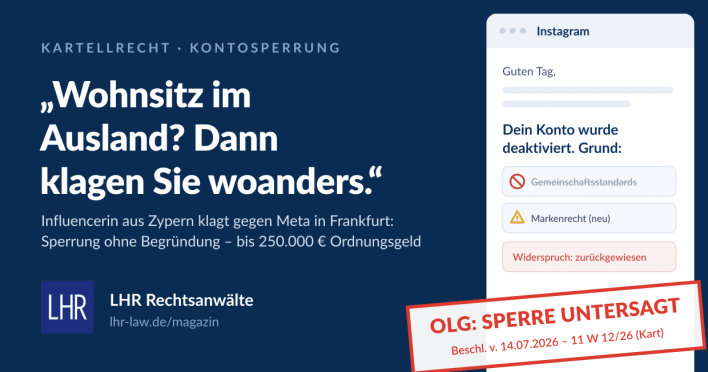

Particularly noteworthy: the applicant is not domiciled in Germany, but in the Republic of Cyprus. For that reason, the Regional Court (Landgericht) of Frankfurt had dismissed the application as inadmissible for lack of international jurisdiction.
The 1st Antitrust Senate of the OLG Frankfurt has now made clear: German courts do have jurisdiction under Art. 7(2) of the Brussels Ia Regulation – what matters is not where the affected party is domiciled, but where the block takes effect.
The case: blocked without reasons – and with shifting justifications
The applicant runs a high-reach Instagram account with almost 1 million followers, aimed to a significant extent at a German-speaking audience. On 28 April 2026, Meta deactivated the account without prior warning. The only justification offered was a blanket assertion that the “Community Standards” had been violated – Meta did not disclose which content was supposed to have breached which rule. The appeal lodged immediately was rejected on 30 April 2026, again without any further explanation.
On 4 June 2026, a remarkable spectacle followed: the account was reactivated – and blocked again within a matter of seconds. This time, the stated reason was that the applicant had violated “terms of use protecting intellectual property rights, including our trademark policies”. This accusation, too, remained entirely unsubstantiated. No ground for the block was apparent to the applicant; there is much to suggest that uncontrolled automated systems were at work here.
First instance: LG Frankfurt denies international jurisdiction
The Regional Court of Frankfurt am Main dismissed the application for a preliminary injunction as inadmissible (order of 16 June 2026, case no. 2-06 O 200/26, confirmed by the order of 30 June 2026 declining to amend the decision).
Its reasoning: the German courts lacked international jurisdiction. This view reflects an objection that is currently raised frequently against affected parties domiciled abroad – and one that deters many of them from asserting their rights against platforms at all.
The OLG Frankfurt’s decision: jurisdiction established on two independent grounds
On the applicant’s immediate appeal (sofortige Beschwerde), the 1st Antitrust Senate of the OLG Frankfurt reversed the decision and issued the requested preliminary injunction. Meta was prohibited from deactivating the applicant’s account, on pain of an administrative fine of up to EUR 250,000 (or, in the alternative, administrative detention). Despite being given the opportunity to respond in the appeal proceedings, Meta did not submit any statement.
On international jurisdiction, the Senate sets out no fewer than two routes:
First, Art. 35 of the Brussels Ia Regulation (Regulation (EU) No 1215/2012), which the Regional Court had not even considered: provisional measures may be applied for before the courts of one Member State even where the courts of another Member State have jurisdiction as to the substance of the matter. For interim relief, the question of whether German, Cypriot or Irish courts would have jurisdiction over the main proceedings is therefore, in the first instance, irrelevant.
Second – and this is what the Senate primarily relies on – Art. 7(2) of the Brussels Ia Regulation: the potential violations of Section 19(1), (2) no. 1 and Section 20(1) sentence 1 of the German Act against Restraints of Competition (GWB) constitute matters relating to tort within the meaning of that provision. The fact that the parties are also bound by contract changes nothing in this respect – the Senate refers to the Federal Court of Justice’s Wikingerhof/Booking.com case law (judgment of 10 February 2021, case no. KZR 66/17).
A contractual clause purporting to allow Meta to block accounts without giving reasons would in any event be void under Section 134 of the German Civil Code (BGB) on account of the antitrust violation.
The decisive point is the determination of the place where the damage occurred (Erfolgsort): the primary harm to the applicant lies in the fact that she is prevented from distributing her content – and, given the language of her posts, her target audience and her follower base, specifically also in Germany.
The application for an injunction was directed exclusively against the impairment in Germany. Germany is therefore the place where the harmful event occurred. The applicant’s place of residence is irrelevant.
On the merits: an arbitrary block as discriminatory treatment in breach of antitrust law
On the substance, the Senate bases the injunction claim on Sections 33(1) and 20(1) sentence 1 in conjunction with Section 19(1), (2) no. 1 GWB. Notable for practitioners: whether Meta holds a dominant market position could be left open. Meta’s relative market power vis-à-vis the dependent applicant is sufficient. The Senate convincingly establishes this dependency by pointing out that the block cuts the applicant off from her followers, that she cannot even notify them of a move to another platform, and that the platform is therefore not substitutable – not even through her presence on other channels.
A block issued without any specific reasons, for which no ground is apparent and whose abstract justification moreover keeps changing, must accordingly be treated as a groundless and arbitrary block. By imposing it, Meta treats the applicant, without objective justification, differently from other undertakings on which no such blocks are imposed.
The Senate also affirmed urgency: the ongoing block threatens the permanent loss of the applicant’s followers – harm that could no longer be undone even by later success in the main proceedings. The period of just under six weeks between the first block and the filing of the application was in any event immaterial, given the interim reactivation and the immediate re-blocking on different grounds.
A procedural side note: objections must be lodged with the Regional Court
Finally, the order is also worth reading for its detailed instructions on legal remedies: an objection (Widerspruch) against a preliminary injunction issued by the appellate court must – continuing a line of authority reaching back to the Imperial Court of Justice (Reichsgericht, RGZ 29, 396) – be lodged with, and decided by, the court of first instance. The Senate expressly describes the diverging decisions of the Berlin Court of Appeal (Kammergericht, order of 8 July 2004, case no. 12 W 21/04) and the OLG Dresden (order of 2 January 2024, case no. 4 W 94/22) as “legally erroneous”.
Context: the myth of “foreign residence as a bar to litigation”
The decision joins a now well-established line of case law subjecting platform decisions to effective judicial review – from the Regional Court of Berlin (judgment of 28 July 2025, case no. 61 O 99/25 Kart eV, discussed in our article Kontosperrung: LG Berlin stärkt Rechte von Influencern gegenüber Instagram [in German]) and the OLG Düsseldorf (judgment of 2 April 2025, case no. VI-U (Kart) 5/24) to the recent order against Google over a YouTube video block, obtained by LHR before the Regional Court of Düsseldorf (LG Düsseldorf, order of 1 July 2026, case no. 36 O 80/26 [Kart] [in German]).
What is new and of real practical significance about the Frankfurt order is above all one point: in advisory practice – and in part also in widely read legal guides – influencers domiciled abroad are told time and again that they have no recourse against account blocks before German courts. That is wrong.
For international jurisdiction under Art. 7(2) of the Brussels Ia Regulation, what matters is not where the affected party lives, but where the block takes effect. Anyone who reaches a German audience with German-language content is harmed by the block specifically in Germany – and can bring proceedings here. This applies to a residence in Cyprus just as it does to other cross-border constellations, such as coaches and influencers based in Dubai [in German].
Practical takeaways
Commercial account operators – influencers, coaches, shops, businesses – can draw three lessons from the decision. First: blanket justifications for blocks can be challenged. Those who are never told which content is supposed to have breached which rule cannot defend themselves – and this is precisely what the courts increasingly treat as unfair hindrance or discriminatory treatment without objective justification. Second: prompt documentation pays off. Screenshots of the block notifications, the appeal history and evidence of reach in Germany support the prima facie showing required in expedited proceedings. Third: residence abroad is no obstacle. What matters is the effect in Germany.
Instagram account blocked? How LHR can help
If your Instagram account, your business channel or another platform access has been blocked, the case should be reviewed promptly – particularly where ongoing brand collaborations, the threat of further sanctions or substantial losses of revenue are at stake, fast action can be decisive. LHR reviews platform blocks out of court and, where necessary, enforces reinstatement in expedited court proceedings – as in the case before the OLG Frankfurt discussed here. An overview of the procedure, a checklist of the documents required and answers to frequently asked questions can be found on our topic page Instagram-Konto gesperrt? So wehren Sie sich [in German].
Account or channel blocked? We will review your case at short notice.
Whether Instagram, TikTok, YouTube or Google Ads: LHR enforces your rights against the platform – out of court and in court. Including where you are domiciled abroad.
Further information on taking action against account blocks is also available on our topic pages TikTok-Konto gesperrt and Plattform-Konto entsperren [both in German].
(Disclosure: LHR acted for the applicant. Higher Regional Court of Frankfurt am Main, order of 14 July 2026, case no. 11 W 12/26 (Kart); court of first instance: Regional Court of Frankfurt am Main, case no. 2-06 O 200/26.)
Related posts