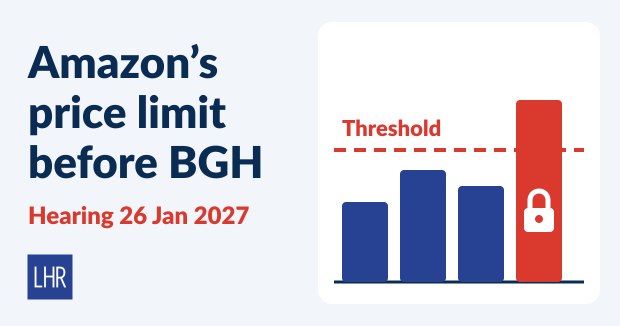

Anyone selling on amazon.de knows the problem: an offer drops out of the Featured Offer, often called the “Buy Box”, or is deactivated altogether because Amazon considers the price too high. Where exactly the limit lies is usually not disclosed to the seller. The German Federal Cartel Office (Bundeskartellamt) prohibited this practice on 4 February 2026 and ordered the disgorgement of around EUR 59 million in economic benefits. Amazon is challenging the decision before the German Federal Court of Justice (Bundesgerichtshof, BGH). In press release no. 201/2026 of 23 October 2026, the court’s antitrust panel has now announced the first hearing date.
- The Federal Cartel Office prohibits Amazon from deactivating third-party offers or excluding them from the Featured Offer merely because their price exceeds thresholds calculated by Amazon (decision of 4 February 2026, case no. B 2 – 73/20).
- Amazon has appealed to the BGH and applied for an order granting the appeal suspensive effect. The implementation deadlines are suspended until these interim proceedings are concluded.
- The hearing on 26 January 2027 will initially focus on Amazon’s objection that the Federal Cartel Office lacked the power to act under EU law. Further hearings are planned.
- Sellers should already document deactivations and losses of the Featured Offer and use their rights under the P2B Regulation.
What has the Federal Cartel Office prohibited?
The Federal Cartel Office has prohibited Amazon from steering the prices of independent sellers on the German marketplace by means of so-called price control mechanisms. According to the authority’s press release of 5 February 2026, Amazon checks the prices of marketplace sellers. If Amazon considers a price too high, the offer is either removed or excluded from the Featured Offer. Both lead to significant losses in sales for sellers, because a large share of purchases is made via this box.
The authority bases its decision on the special provision for large digital companies in Section 19a(2) of the German Act against Restraints of Competition (Gesetz gegen Wettbewerbsbeschränkungen, GWB), on the general prohibition of abuse in Section 19 GWB and on Art. 102 TFEU. It is already established with final effect that Amazon is of “paramount significance for competition across markets” within the meaning of Section 19a(1) GWB; the BGH had upheld that designation.
The core of the reasoning: Amazon is itself a retailer on its own marketplace and therefore a direct competitor of third-party sellers. Whoever controls the prices of its competitors can influence the price level of the entire platform. According to the Federal Cartel Office, amazon.de accounts for around 60 per cent of German online retail revenue from goods, and around 60 per cent of the goods sold there come from independent sellers. The authority considers less intrusive means possible, such as lower fees for sellers, if Amazon wants to promote low prices. It also criticises the lack of transparency: sellers cannot tell how the price limits are set or roughly where they lie.
Price controls are not banned entirely. According to the BGH press release, interventions remain permissible where a price is grossly disproportionate to the service, in particular in cases resembling usury, or where it violates other statutory pricing rules. For these cases, Amazon must inform sellers about how the mechanisms work, how often the thresholds are adjusted and what the consequences of a sanction are. Special requirements apply to notifications in individual cases.
Why does Amazon not yet have to implement the order?
Because, in addition to its appeal, Amazon has applied for an order granting the appeal suspensive effect, and the implementation deadlines are suspended until these interim proceedings have ended. This is how the BGH describes it in its press release. For sellers, this means that the price control mechanisms may continue to operate for the time being. A seller whose offer is deactivated today because of an allegedly excessive price cannot yet rely on the order of the Federal Cartel Office.
The BGH has jurisdiction because appeals against decisions under Section 19a GWB are heard not by a Higher Regional Court but directly by the antitrust panel of the BGH as the first and final instance (Section 73(5) GWB). The legislator intended this to speed up proceedings against large digital companies. In the interim proceedings, the panel examines whether there are serious doubts as to the lawfulness of the order. Only then will it be clear whether Amazon must comply before the decision on the merits.
What will the BGH hear on 26 January 2027?
The first hearing will focus on Amazon’s objection that the Federal Cartel Office lacked the power under EU law to issue the order. The panel has indicated that more than one hearing is planned. The substantive questions, namely whether the price controls are abusive, are likely to be addressed later.
The press release refers to Art. 1(6), second sentence, points (a) and (b) of the Digital Markets Act (Regulation (EU) 2022/1925), Art. 1(5)(c) and Art. 3(2) of the E-Commerce Directive 2000/31/EC and Section 3(2) and (4) no. 8 of the German Digital Services Act (Digitale-Dienste-Gesetz, DDG). Two fundamental questions are therefore at stake:
- How far may a national authority impose its own conduct obligations on gatekeepers under Section 19a GWB alongside the Digital Markets Act, which is enforced by the European Commission?
- Does the country-of-origin principle of the E-Commerce Directive preclude a German order against a provider that offers its service from another Member State? The addressees of the order are Amazon.com, Inc. and Amazon EU S.à r.l., which is based in Luxembourg.
The answers reach beyond Amazon. They affect all proceedings of the Federal Cartel Office under Section 19a GWB, for example against Alphabet, Meta, Apple or Microsoft. If the BGH considers the EU law questions not to be clearly settled, a reference to the Court of Justice of the European Union is possible. That would prolong the proceedings considerably.
What does the EUR 59 million disgorgement mean?
In addition to the prohibition, the Federal Cartel Office ordered Amazon to surrender around EUR 59 million in economic benefits. It is the first case in which the authority has used its power to disgorge economic benefits under Section 34 GWB, which was reformed in 2023; since the reform, the benefit can be determined with the help of a statutory presumption. Because, in the authority’s view, the infringement is ongoing, this is only a partial amount. This order is not final either.
For sellers, the amount is a signal: the authority assumes that Amazon has derived a measurable benefit from steering prices. The money, however, goes to the state and not to the sellers affected.
What rights do sellers already have if an offer disappears because of its price?
Even without an enforceable order of the Federal Cartel Office, sellers are not without rights. The most important basis is the P2B Regulation (Regulation (EU) 2019/1150), which applies to online marketplaces in their relationship with business users:
- If Amazon restricts or suspends its service in relation to individual offers, it must provide the seller with a statement of reasons before or at the time the measure takes effect (Art. 4(1) P2B Regulation).
- Amazon must set out the main parameters determining ranking in its terms and conditions (Art. 5 P2B Regulation).
- Sellers can use the internal complaint-handling system that Amazon must provide (Art. 11 P2B Regulation).
If an offer’s visibility is restricted because of an alleged breach of Amazon’s policies, a duty to state reasons (Art. 17 DSA) and the internal complaint-handling system for online platforms (Art. 20 DSA) under the EU Digital Services Act may also apply.
Damages for unlawful price controls under Section 33a GWB require an infringement of competition law. Under Section 33b GWB, the findings of the Federal Cartel Office only bind the civil courts once the decision has become final. Until the BGH has ruled, a seller would have to set out and prove the infringement itself, which is difficult in practice. The limitation period for such claims is suspended while proceedings by the competition authority are pending (Section 33h(6) GWB). Sellers therefore do not lose claims simply because they wait for the outcome.
What does this mean for marketplace sellers and manufacturers, including those from China?
For sellers on amazon.de, the situation will remain open until at least early 2027. This applies in particular to manufacturers and sellers from China, who make up a large share of third-party sellers on the German marketplace and often use dynamic pricing. For them, there is the additional question of whether a German authority may act at all against a platform operator based in Luxembourg. That is exactly what the BGH will hear in January.
Our recommendations:
- Document every intervention. Record the date, time, ASIN and a screenshot of when an offer was deactivated or lost the Featured Offer, which price applied and which message Amazon sent. Keep your sales figures from before and after the intervention.
- Ask for reasons. If no reasons are given or they remain generic, follow up with reference to Art. 4 P2B Regulation and use the internal complaint procedure. Keep all correspondence.
- Review your pricing. Irrespective of competition law, prices must comply with the German Price Indication Ordinance (Preisangabenverordnung, PAngV) and the German Act against Unfair Competition (Gesetz gegen den unlauteren Wettbewerb, UWG). Amazon remains entitled to intervene where statutory pricing rules are breached, even under the order.
- Keep an eye on the calendar. If the BGH does not grant suspensive effect, the implementation deadlines will start running again. Amazon will then have to change its mechanisms and inform sellers.
- Act immediately if a block threatens your business. If an entire account or a high-revenue range is blocked, a preliminary injunction against Amazon may be an option. Speed is essential.
Frequently asked questions on Amazon’s price controls
May Amazon currently deactivate my offer because the price is too high?+
When will the BGH decide?+
Will I receive money from the EUR 59 million disgorgement?+
Does the decision also apply to sellers from China?+
What should I do now?+
Has Amazon deactivated your offer or removed it from the Featured Offer because of its price?
We review your rights against Amazon and enforce them, out of court or in urgent proceedings. You will usually receive an initial assessment within 24 hours.
Further information
- BGH: Amazon is of paramount significance for competition across markets (in German)
- Preliminary injunction against Amazon: requirements, procedure, risks (in German)
- Complaint, mediation, dispute resolution: out-of-court options against an Amazon account suspension (in German)
- What an Amazon account suspension costs, and what fighting back costs (in German)
- BGH, press release no. 201/2026 of 23 October 2026 (in German)
- Bundeskartellamt, press release of 5 February 2026
- Our fields of activity
- Our successes
Related posts